
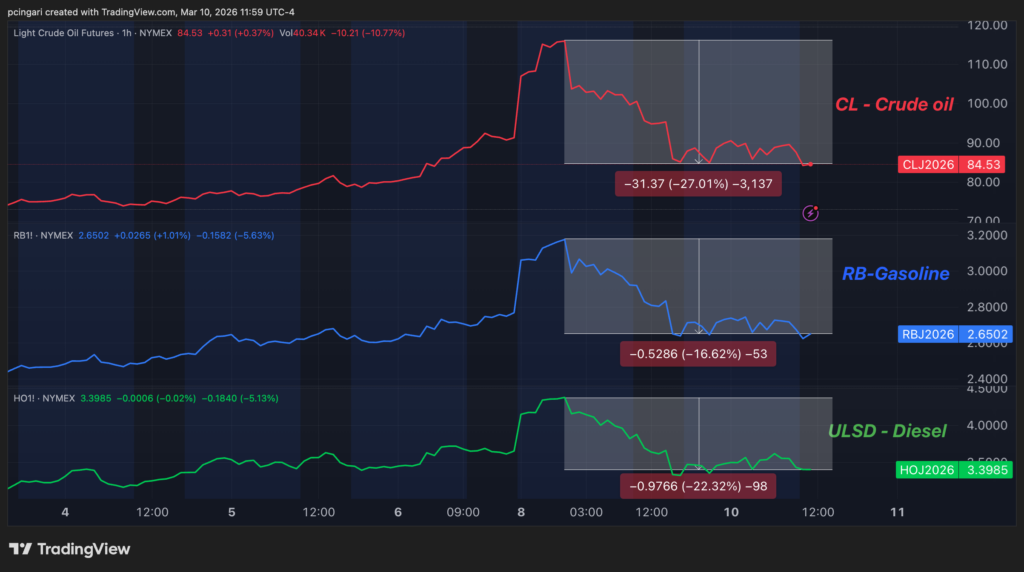
The war in Iran sent crude oil on the most violent round-trip in its trading history.
On Sunday night, WTI futures briefly touched $119 a barrel as fears over a prolonged Strait of Hormuz closure reached fever pitch.
By Tuesday, following President Donal Trump‘s Monday evening press conference declaring the campaign “pretty well complete” and pledging open oil lanes, WTI had retreated all the way to around $84 — a drop of nearly 30% from peak in under 48 hours, the most volatile high-to-low swing in crude since April 2020.
Part of that historic reversal is also operational. Saudi Arabia has begun moving barrels east-to-west through a pipeline that bypasses the Strait of Hormuz entirely, delivering crude directly to the Red Sea.
Saudi Aramco — the world’s largest oil company — confirmed to Benzinga on Tuesday that it has adjusted crude cargo operations in response to the conflict, temporarily rerouting allocated volumes through the East–West pipeline to Yanbu as an alternative for customers unable to enter the Arabian Gulf.
“We remain fully committed to supporting and serving customers and are continuously assessing conditions with the aim of resuming standard procedure,” a spokesperson said.
As fears on oil supply disruptions fade, also gasoline futures – tracked by the RBOB contract – have followed lower, falling 18% from a high of $3.22 per gallon to the current $2.65.
Diesel futures – tracked by the have been even more dramatic, down 22% from $4.47 per gallon to $3.39.
The relief at the pump for American consumers? Essentially zero.

How High Are US Gasoline And Diesel Prices Today?
Crude oil is down 30% from its peak, and wholesale gasoline is down 18%. However, Americans are still paying more for a gallon today than they did yesterday.
According to the AAA national average published Tuesday, regular unleaded gasoline is now running at $3.539 per gallon — up from $3.478 yesterday, $3.109 a week ago, and $2.921 a month ago.
That is a 43-cent increase in a single week.
Diesel is worse. The national average stands at $4.780, up from $4.656 yesterday and $3.891 a week ago — a jump of nearly 90 cents in seven days.
In the California market, the average for regular gasoline hit $5.290 per gallon on Tuesday — up from $5.204 yesterday and $4.674 a week ago. That marks a near 62-cent weekly jump in the country’s most expensive fuel market.
In premium metro areas, the numbers are eye-watering. In Napa, San Francisco and San Rafael, a gallon of regular gasoline is running above $5.50.
Diesel in San Rafael has reached $6.77 — a figure that is not far from the all-time national record of $7.291, set on June 17, 2022 during the post-Ukraine price spike.
Why Pump Prices Aren’t Falling Yet
The gap between where wholesale markets price fuel and where consumers actually buy it is not a rounding error. It is a structural feature of the downstream distribution chain, and it is called “rockets and feathers.”
Prices at the pump rise rapidly when wholesale costs spike — and fall slowly, or not at all, when wholesale costs come back down.
Distributors and retailers are under no obligation to pass savings through immediately, and in a period of acute uncertainty like the current one, few are inclined to do so.
The result is a striking disconnect between falling wholesale fuel markets and rising retail prices.
Trump: Prices Will ‘Drop Rapidly’
Trump addressed the oil price surge directly in Monday’s press conference, indicating the current pain as “a very small price to pay.”
He stressed prices will “drop rapidly” once the nuclear threat from Iran is fully neutralized, pointing to the partial waiver of oil-related sanctions and Venezuela’s 100-million-barrel crude supply already flowing into Houston refineries as near-term relief mechanisms.
“We’re looking to keep the oil prices down,” Trump said when asked about the sanction waivers.
“They went artificially up because of this excursion. I knew oil prices would go up if I did this — they’ve gone up probably less than I thought.”
He confirmed the U.S. is offering political risk insurance to tankers operating in the Gulf, and reiterated that naval escorts would be available if needed to keep the Strait of Hormuz open.
On the question of when the war ends, he was unambiguous: “I think so,” he said, when asked whether it could be over within days.
But on March 8, Defense Secretary Pete Hegseth indicated that the military campaign against Iran “has only just begun.”
Refiners Benefit; Retail Gas Stations? Not So Much
When crude and wholesale fuel prices fall, but retail prices remain elevated, the extra margin is captured by the downstream fuel chain — refiners, distributors, and, to a lesser extent, gas station operators.
Refiners are the most direct beneficiaries. Lower crude inputs combined with still-high fuel prices widen the so-called crack spread, boosting margins for companies such as Valero Energy (NYSE:VLO), Marathon Petroleum (NYSE:MPC) and Phillips 66 (NYSE:PSX).
Shares of Valero, Marathon and Phillips rose by 1.7%, 1.9% and 1% respectively on Tuesday despite the selloff in oil prices.
Fuel distributors — including World Kinect (NYSE:WKC) and Sunoco LP (NYSE:SUN) — can also capture extra margin when wholesale prices drop faster than retail prices adjust.
Retail gas station chains benefit last. Companies such as Murphy USA (NYSE:MUSA) and Casey’s General Stores (NASDAQ:CASY) typically operate on thin margins, but those can temporarily widen during the classic “rockets and feathers” pricing pattern.
Image: Shutterstock
Recent Comments