
European central bankers are losing their reputation for independence amid a spike in international and domestic economic uncertainty.
Resignation decisions by heads of the European Central Bank (ECB) and the Banque de France have fueled accusations about the politicization of European institutions. ECB President Christine Lagarde plans to resign earlier than her end date in October 2027, the Financial Times reported, citing an insider “familiar with her thinking.”
The ECB denied the report. They told the British newspaper that she has not made “any decision regarding the end of her term.” François Villeroy de Galhau, France’s 66-year-old central banker, will leave his post in June after almost 11 years.
Questions about the independence of European central bankers come at a time of economic uncertainty. The Israel–US military strikes on Iran have sent oil and gas prices higher. The euro is under pressure. Core inflation could accelerate in the Euro Area. This creates a pivotal moment for ECB leadership
“The conflict is hardly distant,” Wolfgang Munchau, director of European political and economic analysis group Eurointelligence, wrote on Tuesday. “It already threatens to affect Europe economically, and perhaps politically too.”
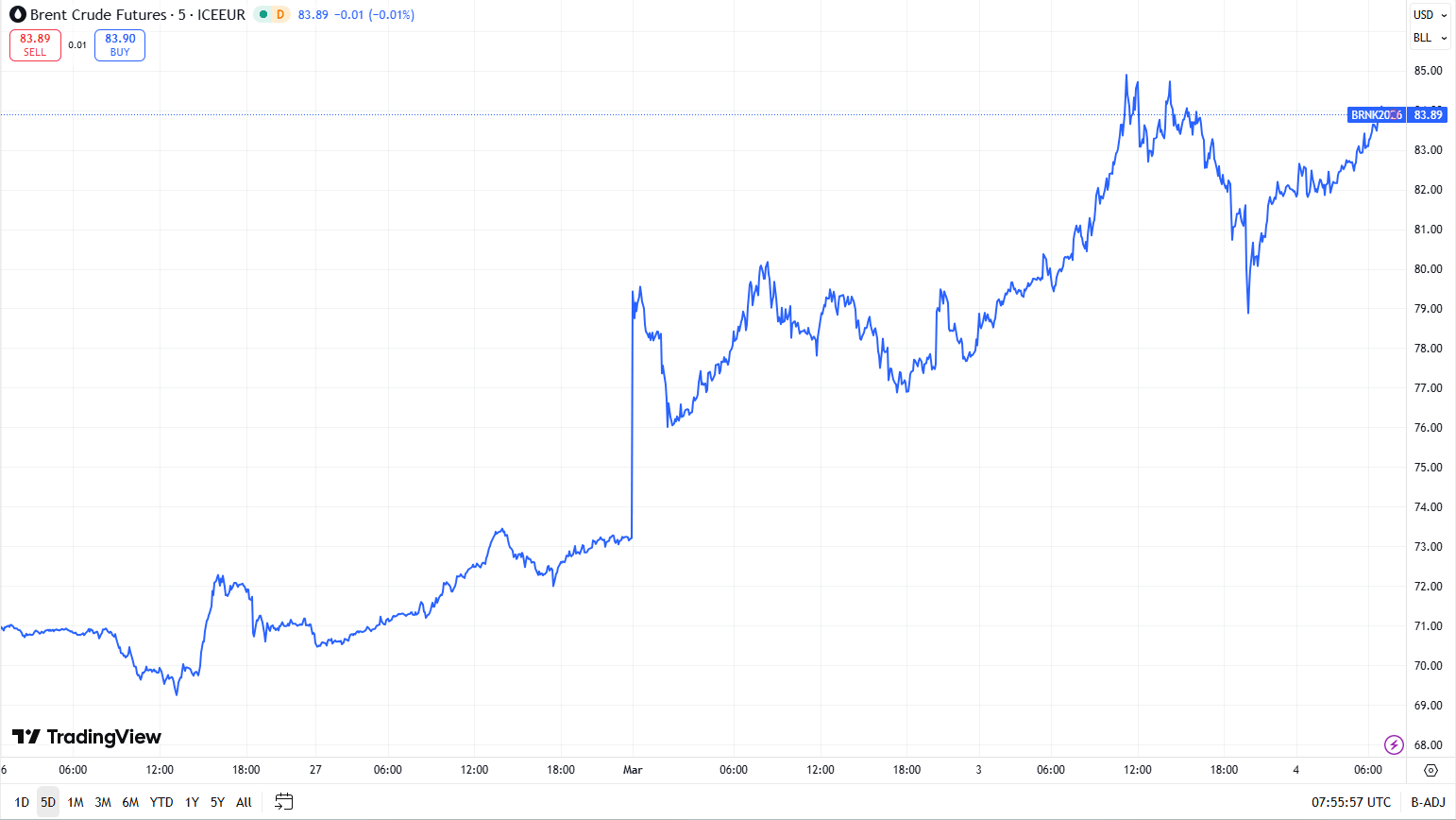
Brent oil has risen sharply in the past five days, source: TradingView
Aramco halted operations at Saudi Arabia’s 550,000-barrel-per-day Ras Tanura refinery after a drone strike in the area. There was a “limited” fire at the plant, caused by debris, the official Saudi Press Agency said. Saudi defenses intercepted two drones that were targeting the facility.
Oil prices rose 4.2% on Wednesday as the US–Israeli campaign against Tehran heightened fears of supply disruption. Brent is up around 18% over the past week.
This supply shock has hit Europe at a critical time for ECB leadership.
ECB Leadership Position Opens Ahead of French Elections
Analysts have interpreted Lagarde’s potential departure as a political move. She will depart ahead of the French presidential elections in April 2027. French President Emmanuel Macron and German Chancellor Friedrich Merz will have a say in appointing her replacement, Euronews reported.
“The rationale here is that a swifter departure would allow Macron and Merz to appoint a new president ahead of the French presidential elections,” ING Think’s Carsten Brzeski, Global Head of Macro, wrote on February 18. “Whether this is a political strategy that all French voters will appreciate is probably a different story.”
Lagarde has faced scrutiny over a February 20 disclosure that revealed she received a salary of about €140,000 for her position as a board member at the Bank for International Settlements (BIS) in 2025. Lagarde “is not a staff member,” the ECB told the Financial Times. She is “not covered by the staff rules” banning employees from receiving third-party revenues.
Villeroy de Galhau announced his departure nearly 18 months before his term ends. He said in a February letter to employees that he made the decision “with complete personal independence.”
He will run the Fondation Apprentis d’Auteuil, a Paris-based charity for vulnerable youth.
French Opposition Sees Political Power Grab
For opposition parties in France, the early departures are political interference in monetary policy. President of France’s right-wing National Rally (RN) party, Jordan Bardella, accused Macron of orchestrating a “democratic power grab.”
“This would send the signal that European elites are trying to control the institution,” Frederik Ducrozet, head of macroeconomic research for Pictet Wealth Management, told Reuters on February 18. “It could prove counterproductive for everything else that the EU is trying to achieve.”
The opposition has accused French leadership of obstructing the political right. A French court fined the head of RN and Bardella’s political mentor, Marine Le Pen, €100,000. The court barred her from running for office for five years in late March 2025.
A court convicted the 57-year-old former presidential candidate of using funds from her work as an MEP to hire staff. Analysts have described this practice as not “uncommon” for many EU lawmakers and have characterized the ruling as politically motivated.
Weak Economic Data Bolsters Far-Right Criticism
French opposition parties have criticized Lagarde’s tenure. In a February 9 speech, Bardella said the bloc is increasingly “not competitive on a global scale.”
The ECB’s monetary policy can’t “continue over the long term to ignore economic reality,” Bardella said. “Excessive regulatory burdens” have hurt European companies’ competitiveness, and there is an “alarm bell for our production sectors,” he added.
“You’re trying to turn Europe into a vast consumer market rather than a global power in terms of production and innovation.” The economic data appear to support this assessment.
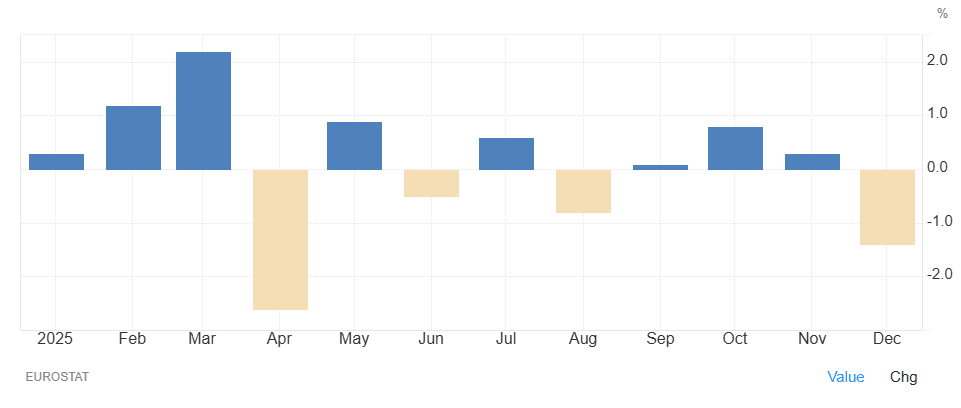
The Euro Area economy expanded by 1.3% year-on-year in the final quarter of 2025. That marked its slowest pace in a year. Euro Area industrial production declined by 1.4% month-on-month in December 2025, reversing a downwardly revised 0.3% increase in November.
Iran Conflict Pushes Eurozone Inflation Higher
The ECB’s Chief Economist, Philip Lane, has warned that a spike in inflation is possible due to the war. In February, Euro Area core inflation jumped from 2.2% to 2.4%.
“Even before the Middle East conflict began, inflationary pressures had far from fully abated,” ING Think wrote on Tuesday. “If the conflict continues for a few weeks, expect inflation to rebound to the mid-2% range. But if a significant disturbance to energy supply lasts longer, the impact is bound to become larger.”
About 20% of the global daily oil consumption passes through the Strait of Hormuz. Saudi Arabia, Iraq, and the United Arab Emirates send most of their oil exports through the Strait. Energy analysts at Barclays predicted crude oil prices would hit $100 a barrel as the market grapples with the threat of a potential supply disruption.
The euro (EURUSD) slid sharply against the dollar on Tuesday. Traders have piled into the dollar amid escalating tensions in Iran.
Mideast War Threatens Eurozone Confidence
Escalation in the Middle East would further erode confidence in the Euro Area economy. The region’s Economic Sentiment Indicator fell to 98.3 in February 2026, down from a three-year high of 99.3 in January.
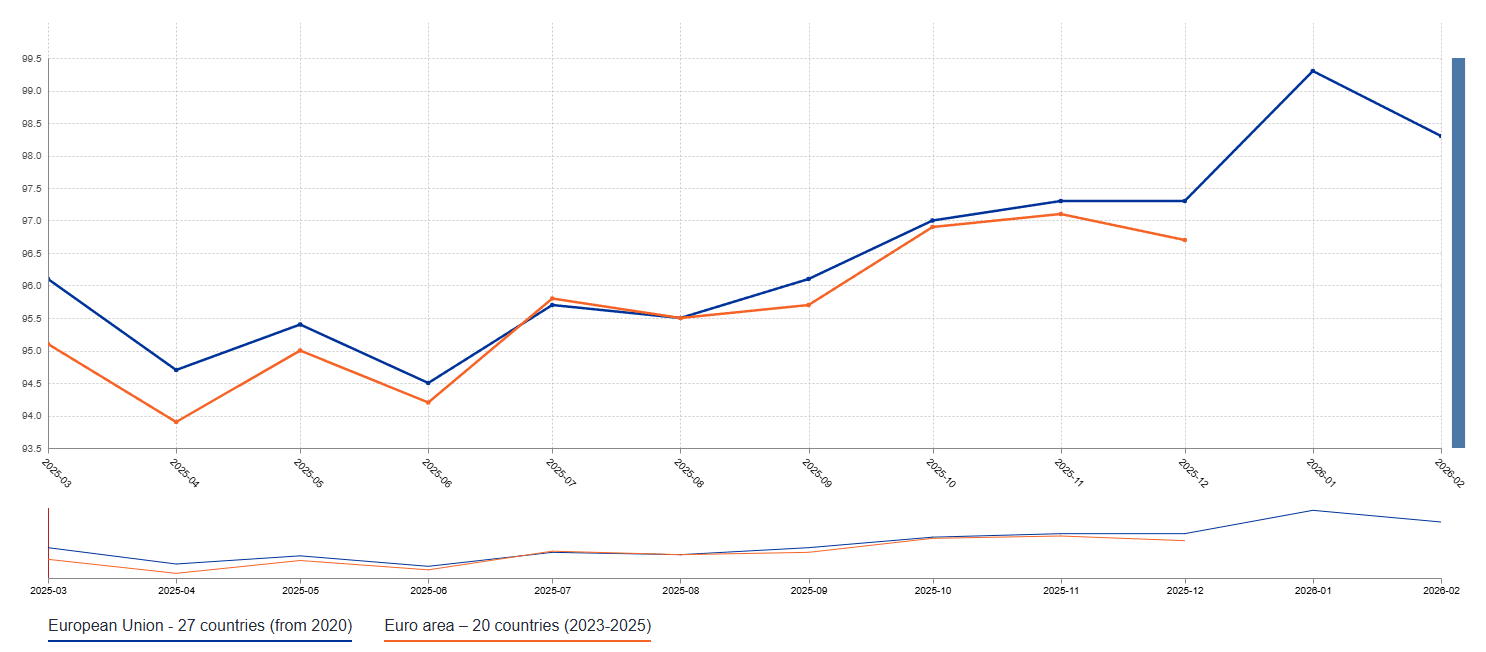
The ZEW Indicator of Economic Sentiment for the Euro Area dropped monthly by 1.4 points to 39.4 in February.
These weak readings occurred before the US-Israel military operations against Iran. Tehran has threatened to attack any shipping transiting the Strait of Hormuz. It has targeted critical oil infrastructure in the Middle East.
“Higher gas prices feed into power prices and industrial margins, especially for gas-intensive sectors,” Simone Tagliapietra, a senior fellow at Brussels-based Bruegel, a European think tank that specializes in economics, said. “Achieving Europe’s goal of lowering industrial energy costs – an issue at the core of EU leaders’ competitiveness concerns – could become more complicated.”
Bardella Leads 2027 Race, Threatens ECB Orthodoxy
Caspar Hobhouse, a Research Analyst at the EU Institute for Security Studies, wrote that it would cause “pain for European consumers and industries.”
The economic fallout from the instability in the Middle East could upset the country’s presidential election in 2027. Bardella has already pulled ahead of other candidates. He would likely get as much as 37.5% of the total vote, a November 2025 poll by Elabe for La Tribune Dimanche and French news outlet BFMTV showed.
A win by RN may also impact monetary policy across the Euro Area. Largely seen as Eurosceptics, Bardella or Le Pen would likely tap a more “unconventional” individual for the ECB presidency.
“Whoever replaces Lagarde will have the task of navigating the new power structures that shape global finance,” Munchau wrote on February 20. “Institutional independence is critically premised on central banking that has a narrow mandate, rather than seeing itself as a savior to the world’s problems.”
Disclaimer: Any opinions expressed in this article are not to be considered investment advice and are solely those of the authors. European Capital Insights is not responsible for any financial decisions made based on the contents of this article. Readers may use this article for information and educational purposes only.
Benzinga Disclaimer: This article is from an unpaid external contributor. It does not represent Benzinga’s reporting and has not been edited for content or accuracy.
Recent Comments