
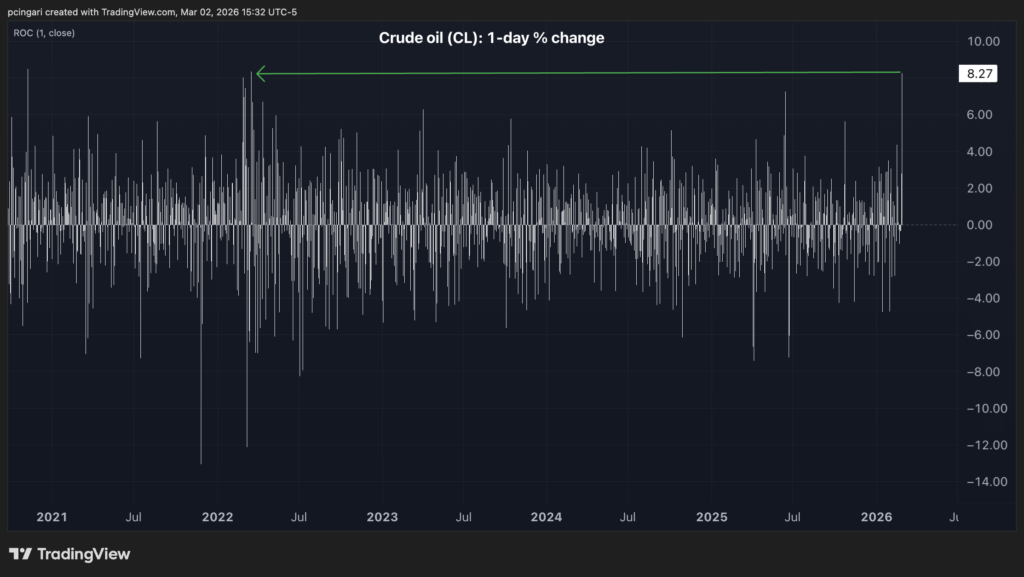
Oil markets are beginning to price in a worst-case scenario.
Crude oil — tracked by the United States Oil Fund (NYSE:USO) — surged 8.3% to $72.50 per barrel, marking its largest single-day gain since March 2022, when Russia’s invasion of Ukraine propelled prices above the $100 level.
The focus now is singular: the Strait of Hormuz.
Roughly one-fifth of global oil and LNG flows pass through the narrow waterway connecting the Persian Gulf to global markets. Any sustained disruption would represent one of the largest energy supply shocks in modern history.
In a note Monday, Goldman Sachs commodity analyst Daan Struyven said tanker traffic through the Strait appears “significantly disrupted,” as shippers, oil producers and insurers adopt a cautious stance amid reports of damaged vessels.

Why Hormuz Is Systemically Important For Energy Markets
Roughly 20 million barrels per day transit the Strait of Hormuz — about one-fifth of global oil supply.
“Strait of Hormuz flows and any potential communication on the Strait by the U.S., Iran, China and GCC countries and on the broader conflict are now the most important variables to watch in energy markets,” Struyven said.
In 2025, flows through the passage averaged 13.4 million barrels per day of crude, alongside refined products, condensates and natural gas liquids.
Saudi Arabia, Iraq and the United Arab Emirates together exported more than 13 million barrels per day via the Strait last year, with China serving as the primary destination. The corridor is equally vital for liquefied natural gas shipments.
Iran itself produced around 3.5 million barrels per day of crude and 0.8 million barrels per day of condensate in 2025, equivalent to roughly 4% of global supply.
While some supply can be redirected, the International Energy Agency estimates only about 4.2 million barrels per day could be rerouted through existing pipeline infrastructure. That leaves as much as 16 million barrels per day theoretically exposed in a full closure scenario.
Goldman Sachs: Significant Disruption, But No Base Case Change
Goldman estimates that a potential 1 million barrel per day supply disruption — roughly half of Iran’s crude exports — would boost the fair value of oil prices by $8 a barrel, though the bank cautions that prices could rise more as escalation risks are reassessed.
But the larger concern is not just Iranian barrels. It is the broader infrastructure risk across the Middle East.
Because Iran has previously targeted oil producers across the region, Struyven notes that future damage to oil production or export infrastructure cannot be ruled out.
Could Oil Prices Reach $100 If Hormuz Closes?
Goldman modeled several one-month disruption scenarios to estimate fair-value impacts on oil prices.
A full one-month closure with no mitigating offsets could lift oil prices by about $15 per barrel.
If all available spare pipeline capacity were utilized, the increase would moderate to roughly $12. If spare capacity were used and global strategic petroleum reserves released at a pace of 2 million barrels per day, the impact would narrow to about $10.
More limited disruptions would have smaller effects. A 50% closure for one month, assuming offsets are deployed, would imply an estimated $4 increase. A 25% disruption would translate to roughly $1.
With crude currently near $72, a full, unmitigated closure scenario could push prices into the mid-to-high $80s.
Importantly, these are fair-value estimates. In periods of elevated geopolitical uncertainty, oil prices often trade well above model-implied levels as risk premia expand.
Upside Risks, But Not a Structural Call
“History shows that oil prices can rise significantly, and well above fair-value estimates when geopolitical uncertainty is high and when the market puts some weight on supply disruptions persisting,” Struyven said.
The closest historical comparison is the September 2019 attack on Saudi Arabia’s Abqaiq facility, which caused the biggest ever single-day oil production disruption and triggered a nearly 20% intraday price move — even though prices moderated as output was restored within just over 10 days.
In mid-2022, oil traded nearly $20 above Goldman’s stocks-implied fair value amid geopolitical tensions over the war in Ukraine.
Despite the current volatility, Goldman continues to project Brent and WTI declining toward $60 and $56, respectively, by the fourth quarter of 2026, assuming no sustained supply disruption.
“Oil prices can normalize quite fast after short-lived geopolitical shocks and/or temporary supply disruptions,” Goldman Sachs said in the report.
Recent Comments