
Weekly Chart: Oil Spikes to 9-Month High on Israel-US Attacks on Iran
Oil prices jumped sharply on Monday as US and Israeli strikes on Iran intensified Middle East tensions. This has heightened concerns over potential disruptions to global energy supplies through the Strait of Hormuz.
US crude (WTI) surged more than 8% to above $72 per barrel. This marked its highest level in nine months as markets rushed to price in escalating conflict risk involving Iran.
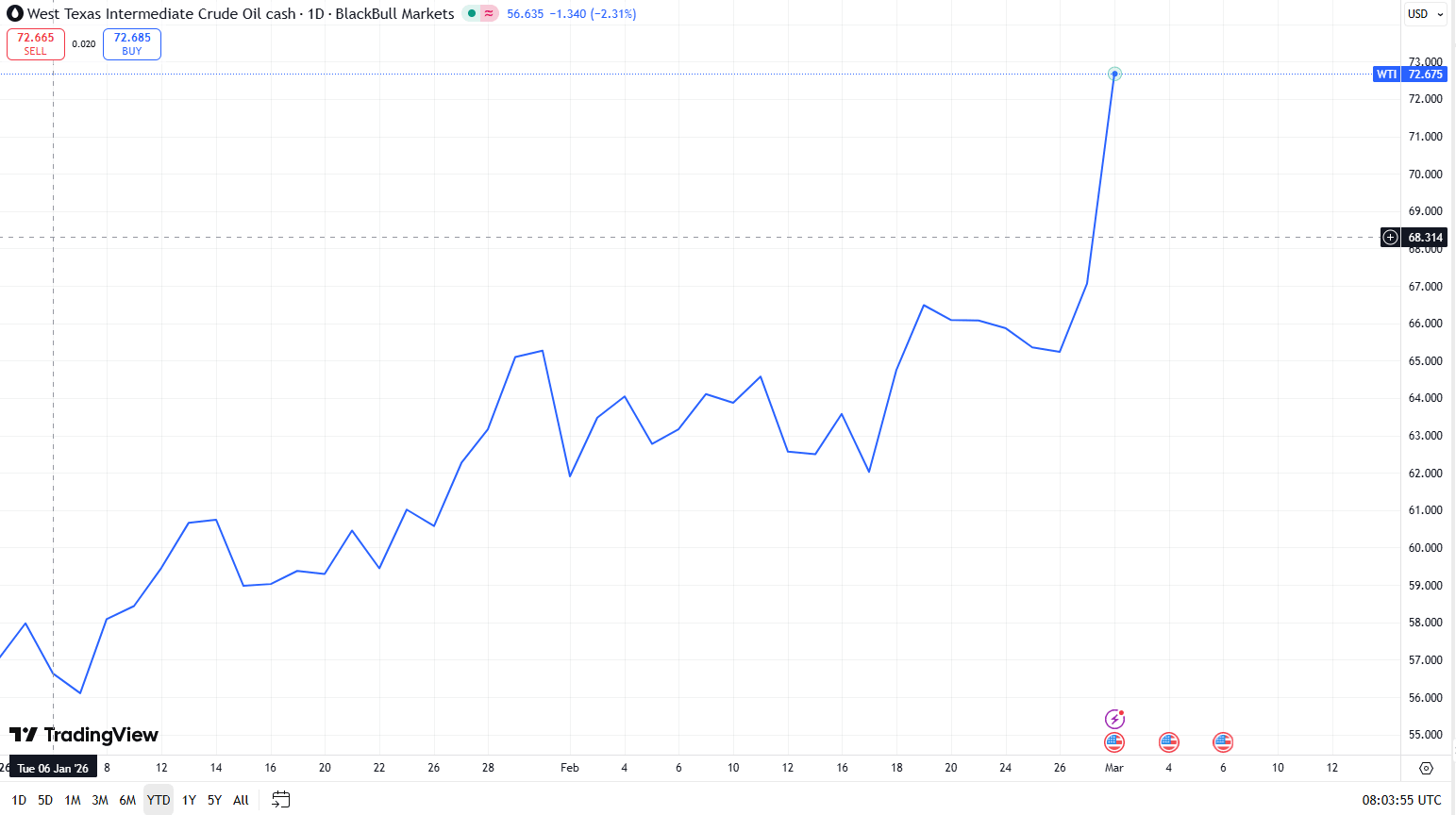
ICE gasoil futures jumped more than 20%, the biggest intraday gain since March 2022. Crude oil in London traded about 10% higher near $80 a barrel.
Aramco halted operations at Saudi Arabia’s 550,000-barrel-per-day Ras Tanura refinery after a drone strike in the area, Bloomberg reported. It cited people familiar with the matter.
There was a “limited” fire at the plant, caused by debris, the official Saudi Press Agency said. Saudi defenses intercepted two drones that were targeting the facility
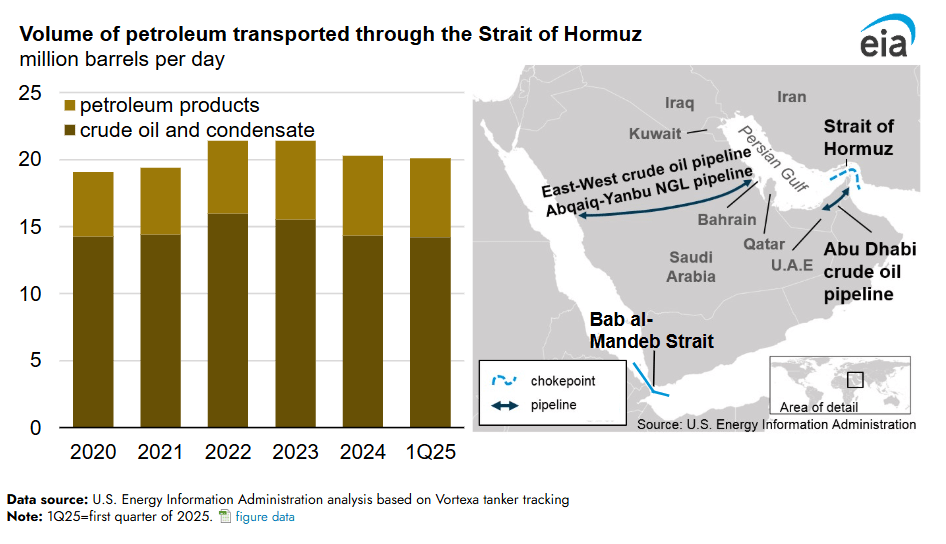
About 20% of the global daily oil consumption passes through the Strait of Hormuz. Saudi Arabia, Iraq, and the United Arab Emirates send most of their oil exports through the strait. Energy analysts at Barclays predicted crude oil prices would hit $100 a barrel with potential supply disruptions.
Why it matters: Europe is vulnerable to disruptions in Middle East energy and global shipping. A sharp oil spike would accelerate inflation, weaken growth, and impact monetary policy for the European Central Bank. A disruption at Hormuz would jeopardize about 10% of Europe’s LNG imports. This would impact industrial production as the cost of power increases.
Geopolitics: Israel, US Military Strikes Against Iran
US, Israel Strike Iran: The Israeli-US military action against Iran has increased concerns about an escalation in the Persian Gulf. The military strikes killed Ali Khamenei, the country’s Supreme Leader, and at least 40 other military, security, and government leaders. President Donald Trump said that the military campaign will continue uninterrupted throughout the week or as long as necessary. He has called for the Iranian people to rise against the Islamic regime.
Germany, France, and the United Kingdom pressed the Trump administration to return to the negotiating table with Tehran. They urged Iran to end its nuclear program, curb its ballistic missile program, and refrain from destabilizing the region. They spoke out against the Iranian regime’s retaliatory strikes on neighboring countries and US bases in the Persian Gulf.
EU High Representative for Foreign Affairs and Security Policy, Kaja Kallas, posted on X that the death of Khamenei was “a defining moment in Iran’s history.” She wrote that there is “now an open path to a different Iran, one that its people may have greater freedom to shape.”
EU Commission President, Ursula von der Leyen, warned that Khamenei’s removal could push the region into a “spiral of violence.” She has engaged with key actors and regional partners to safeguard stability and security and to protect civilian lives.
Why it matters: Conflict in the Middle East risks slowing the Euro Area’s economic growth if oil supplies are disrupted. The bloc’s GDP has eased over the last four quarters. An escalation in the conflict will disrupt logistics and supply lines for the EU. A.P. Møller–Mærsk A/S (OTC:AMKBY) said Sunday it had halted passage through the Suez Canal and the Strait of Hormuz. It cited “safety” reasons. EU officials will push for military operations to end, mindful of the economic impact.
Europe in the News
Merz Visits Beijing: German Chancellor Friedrich Merz arrived in Beijing on Wednesday to address trade and economic imbalances with the European Union (EU). His two-day trip follows visits by Emmanuel Macron in December and Keir Starmer in January, underscoring renewed European engagement with Beijing amid tense transatlantic relations with the Trump administration.
For further reading: Merz Visits Beijing to Fix Trade Imbalance as Xi Purges Senior Military Commanders
EU’s E6 Power Bloc: Europe’s leaders have considered “two-speed” integration—where select member states advance faster on key issues—to break deadlocks on competitiveness and security. The debate intensified in early 2026 with the launch of the so-called E6 grouping of Europe’s largest economies.
For further reading: EU’s E6 Power Bloc: Two-Speed Europe Accelerates in US-China Race
Data This Week: Euro Area Inflation, Germany Retail Sales, Italian GDP
Euro Area:
Core Annual Inflation (Tuesday): Eased to 2.2% in January, the lowest since October 2021, vs 2.3% in December
YoY GDP (Friday): The previous reading showed GDP expanded by 1.3% year-on-year in Q4 2025
Germany:
Change in YoY Retail Sales (Monday): -0.9% (January) vs 1.5% (December).
Change in MoM Factory Orders (Friday): The previous reading showed 7.8% growth in December
Italy:
Full Year GDP: Current reading 0.5% vs 0.8% in 2024
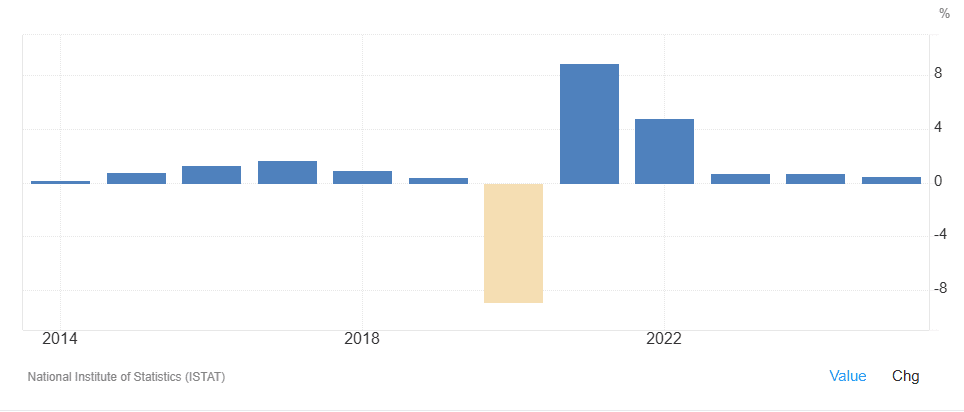
Why it matters: The latest Euro Area data showed core inflation slowing toward the European Central Bank’s target with economic growth remaining modest. This combination gives policymakers space to make gradual rate cuts, without immediately risking a renewed inflation spike. The latest conflict in the Middle East could impact Euro Area inflation rates.
In Germany, retail sales fell by 0.9% in January, missing market expectations for a milder 0.2% drop. The pullback was largely driven by a 1.7% decline in non-food sales. It suggested that households turned more cautious at the start of the year, according to Trading Economics.
EU Meetings: EU to host Security Meeting
Von der Leyen called on Sunday for a credible transition in Iran to halt its nuclear and ballistic missile programs. She urged an end to regional destabilization and restoration of stability. She will host a special Security College meeting today to discuss the ongoing developments in Iran.
Why it matters: The EU wants to maintain regional security and stability to prevent any further escalation. Officials will emphasize the importance of containing the situation and preventing the expansion of tensions. It is unlikely that the Trump administration will heed these calls. European leaders were not informed in advance of the US–Israel strike on Iran.
Policy Moves: Italy Calls for Carbon Pricing Mechanism Suspension
Italy urged on Thursday for the suspension of the European Union’s carbon pricing mechanism for polluting industries. Rome called it a tax on energy-intensive industries.
Italy’s Enterprises Minister Adolfo Urso said the Emissions Trading System (ETS) must be substantially revised to spur EU competition, Euractiv reported. The landmark law that sets Europe’s CO2 price will lead to the “collapse” of European industry, with the minister adding that it will result in the relocation of industrial emissions to other continents.
In Germany, a new law aimed at accelerating hydrogen production, which was passed by parliament, could mark a decisive breakthrough for the technology in Germany, the energy industry group BDEW has said. The law sets the right conditions for the initial phase of Germany’s emerging hydrogen market, said BDEW head Kerstin Andreae.
Why it matters: Euro Area companies have struggled to compete with their US and Asian competitors because of climate change regulations and higher power prices. Urso has called for the EU to address this through an easing of regulations.
For Germany, the Hydrogen Acceleration Act benefits the country by slashing red tape on permitting for electrolyzers, pipelines, import terminals, and low-carbon hydrogen projects, fast-tracking infrastructure rollout through 2045. This would benefit energy-intensive industries, such as BASF SE (OTC:BASFY) and Thyssenkrupp AG (OTC:TKAMY).
Stock in Focus: AIXTRON Rises 19% Last Week Despite Revenue Decline
AIXTRON SE (XETRA: AIXA.DE) reported on Thursday that revenue declined 12% to EUR 557 million, but strong cash flow and Q4 margins were achieved. The company’s stock climbed 19% for the week ending February 27.
Revenue and earnings dropped on weaker demand in power electronics and LED segments, but strong optoelectronics growth and operational efficiency measures led to robust free cash flow and maintained technological leadership. AIXTRON anticipates EUR 520 million revenue in 2026, with optoelectronics growth offsetting silicon carbide (SiC) weakness and stable LED/micro-LED demand.
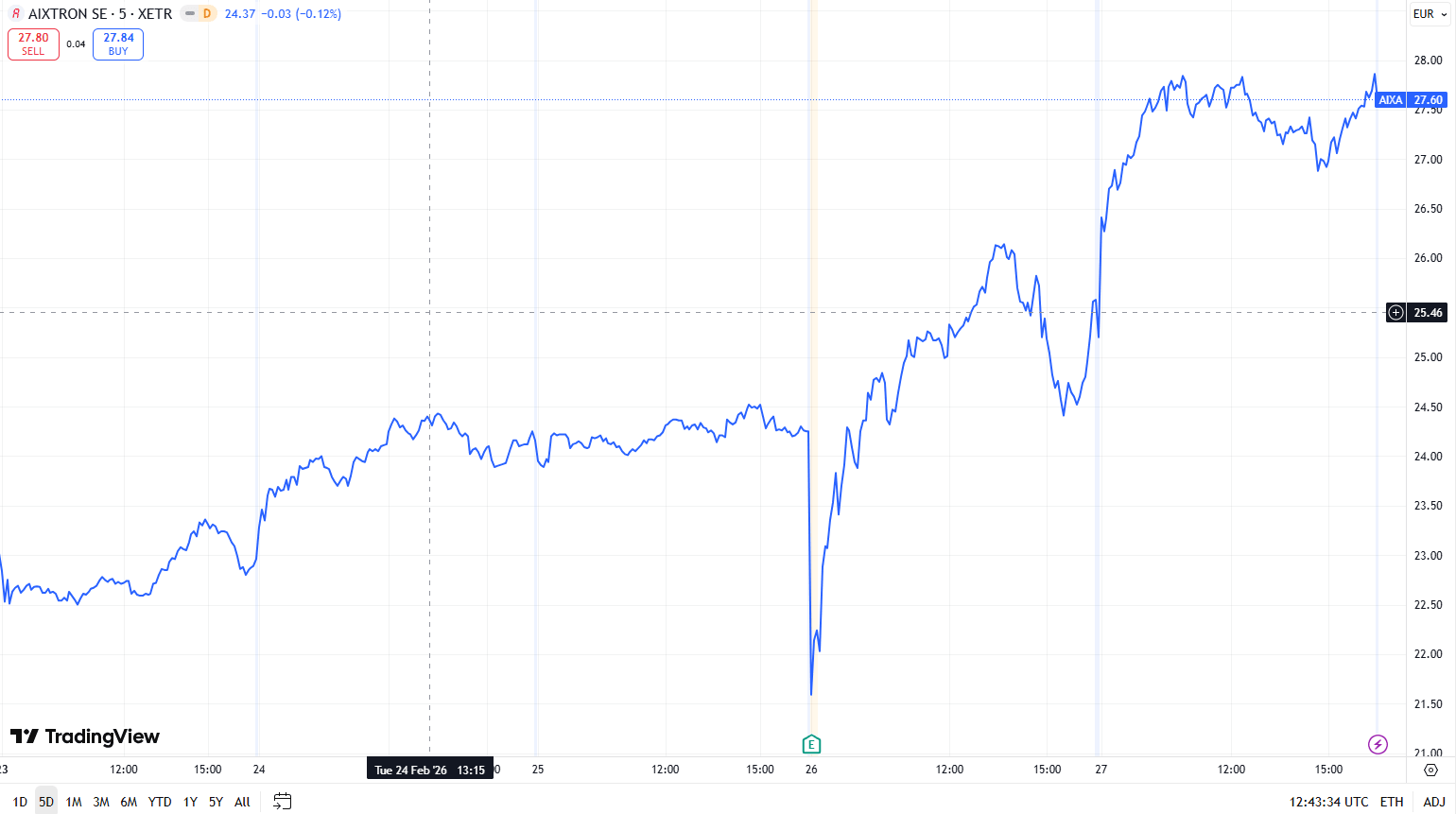
Five-day trading for AIXTRON for the week ended February 27, source: TradingView
Why it matters: AIXTRON’s FY 2025 earnings signal a split European tech landscape. Weakness in SiC power electronics and LEDs reflects electric vehicle slowdowns and overcapacity, plaguing German auto supply chains. AI-driven photonics demand highlights a pivot to high-margin niches.
Disclaimer: Any opinions expressed in this article are not to be considered investment advice and are solely those of the authors. European Capital Insights is not responsible for any financial decisions made based on the contents of this article. Readers may use this article for information and educational purposes only.
Benzinga Disclaimer: This article is from an unpaid external contributor. It does not represent Benzinga’s reporting and has not been edited for content or accuracy.
Recent Comments