
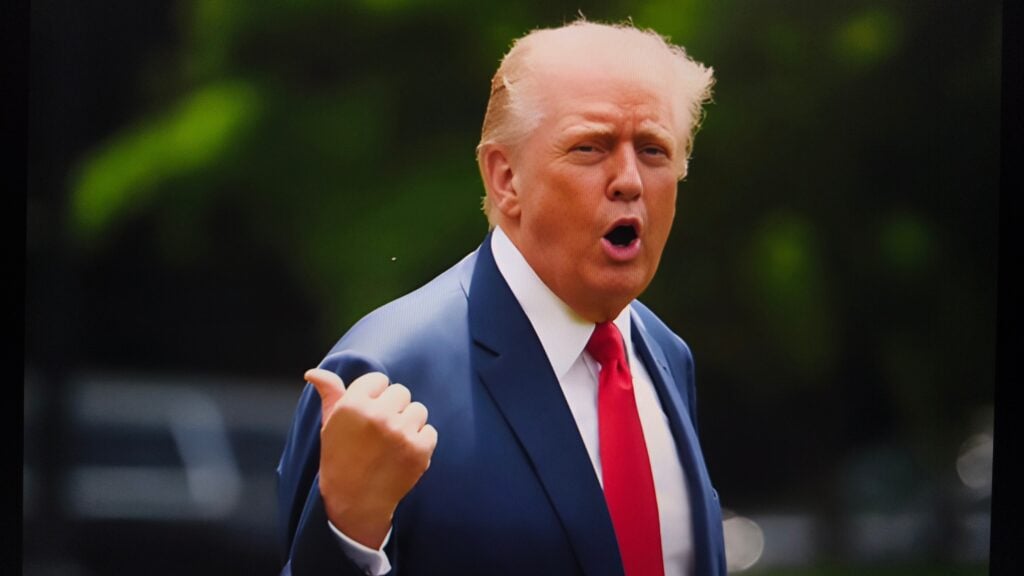
On Saturday, President Donald Trump said in a post on Truth Social that he is lifting a worldwide tariff rate to 15% from 10% and said the change takes effect immediately, framing the move as a response to a U.S. Supreme Court ruling he criticized as “anti-American.” The escalation lands as YouGov poll results show 60% of Americans backing the court’s decision, with many pointing to higher prices they associate with Trump’s tariff agenda.
In the post, Trump described the court’s tariff decision as “ridiculous” and “poorly written,” and said the justices acted after “many months” of consideration.
In the same post, Trump argued that numerous countries have been taking advantage of the U.S. for decades and said his administration will spend the next few months setting what he called new, legally permissible tariff schedules.
Why Trump’s Tariff Strategy Sparks Economic Debate
The Supreme Court ruling Trump referenced was a 6-3 decision issued on Friday that wiped out his earlier tariff approach.
Chief Justice John Roberts joined five other justices in the majority, and the court said the International Emergency Economic Powers Act does not give the president authority to impose tariffs.
Public opinion data has been moving against the tariff push, even as Trump has continued to argue it strengthens the economy.
A Pew Research survey conducted last year found 53% of U.S. adults said Trump’s policies have hurt the economy, and 74% cited inflation, tariffs, and the cost of living as reasons they viewed conditions negatively.
Are Higher Tariffs Really The Solution?
Trump has repeatedly pointed to tariffs as a way to reshape trade flows, including claims tied to a sharp improvement in the trade deficit after his April 2025 tariff rollout.
But official figures later showed the deficit rising 95% by November 2025, a contrast that has fueled questions about how the policy is working in practice.
Economists and trade analysts have also argued that the bill for tariffs largely stays at home, with reports estimating close to 90% of the cost is absorbed by U.S. companies and shoppers rather than foreign exporters.
Trump’s Truth Social statement leaned on a different premise, saying the tariff increase is “legally tested” and that his administration will set updated rates over the next several months, according to Truthsocial.
Trump’s Tariff Maneuver Amid Legal Constraints
This shift in tariff strategy follows Trump’s earlier criticism of the Supreme Court’s ruling, which he labeled as “ridiculous” and “poorly written.” Following the decision, Trump announced a new 10% global tariff under Section 122 of the Trade Expansion Act, indicating that these tariffs could address balance-of-payments issues for up to 150 days. This new approach is framed by Trump as a necessity to counter what he perceives as foreign exploitation of U.S. economic strength.
Despite these announcements, the Supreme Court’s ruling reflected a significant limitation on presidential authority regarding tariff imposition, as it reinforced that only Congress holds the power to levy taxes.
Polls Reveal Public Sentiment Shift
The YouGov poll found 60% support for the Supreme Court striking down the tariffs, and it also captured how many people connect tariffs to price pressures at the register.
In that survey, 66% said they have noticed costs rising for goods, including 88% of Democrats and 68% of independents.
Even among Republicans, the poll showed 44% said tariffs increased prices, while 28% said they saw no impact and 10% said prices fell.
With midterm elections approaching and control of Congress on the line, the combination of the court’s 6-3 ruling and polling on consumer costs is shaping how candidates may talk about trade and inflation on the campaign trail.
Recent Comments