
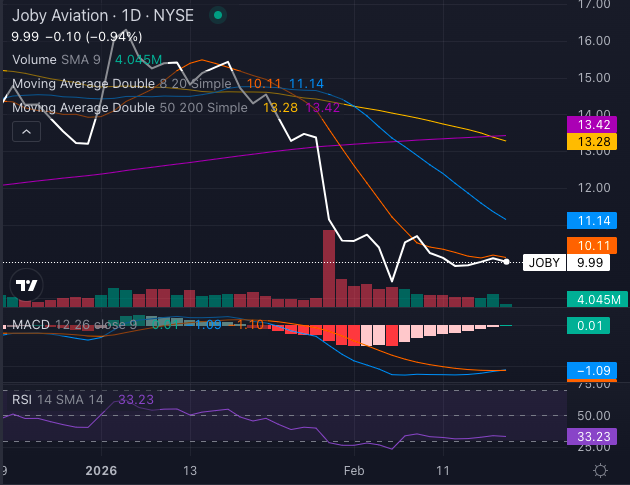
Joby Aviation Inc (NYSE:JOBY) shares have entered a confirmed long-term downtrend, with the stock flashing a Death Cross even as new Pentagon funding places the company inside the U.S. hypersonic technology ecosystem.
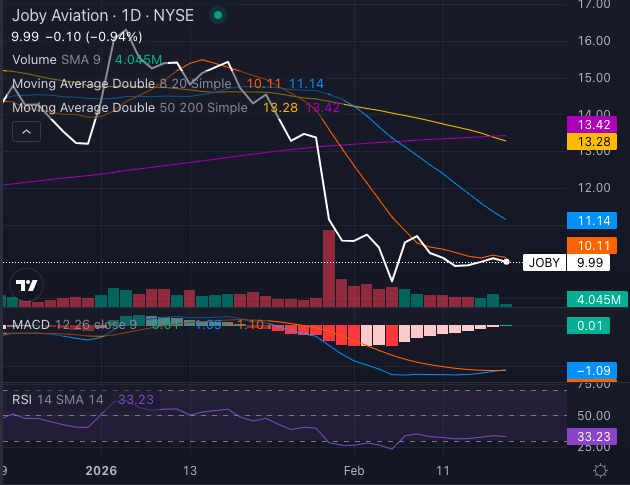
Chart created using Benzinga Pro
JOBY stock is trading near $9.99, down about 30% year-to-date and roughly 52% below its 52-week high of $20.95.
The recent technical breakdown pushed the company’s 50-day moving average to $13.28, falling below the 200-day moving average at $13.42 — confirming a Death Cross, a widely followed signal of long-term trend weakness.
Stock Remains Below Key Trend Levels
Joby is now trading approximately 25% below its 50-day moving average and about 26% below its 200-day moving average. The stock has declined more than 32% over the past month, reflecting sustained selling pressure.
Momentum indicators also remain weak. The Relative Strength Index (RSI) is currently near 33, a level associated with reduced buying activity and persistent downward momentum. Trading volume has averaged about 4.0 million shares in recent sessions, reflecting continued investor repositioning.
Pentagon Program Expands Defense Exposure
Despite the technical weakness, Joby has emerged as one of five companies selected under the Pentagon’s $68 million hypersonic technology development program. The initiative supports next-generation systems capable of speeds above Mach 5 and includes companies involved in aerospace and defense infrastructure.
The company has also partnered with L3Harris Technologies Inc (NYSE:LHX) to explore defense applications for its autonomous aircraft platform, expanding its potential role beyond commercial air mobility.
Manufacturing Expansion Continues As JOBY Stock Tests Resistance
Joby recently agreed to acquire a manufacturing facility in Dayton, Ohio, spanning more than 700,000 square feet. The facility is expected to support plans to increase production capacity to four aircraft per month beginning in 2027.
However, the stock remains well below its 200-day moving average, a key long-term trend level that often determines broader directional momentum.
Photo: ARVD73 / Shutterstock.com
Recent Comments