
Geographical Uniqueness and Territorial Claims
Australia is the only country in the world that occupies an entire continent, ranking sixth globally by land area. In addition to the mainland, Australia maintains territorial claims over approximately 40% of Antarctica. The claims, supported by the United Kingdom, Norway, France, and New Zealand, remain unrecognized under the 1959 Antarctic Treaty, which designates the continent as a shared scientific preserve and prohibits sovereign occupation. If recognized, these claims would elevate Australia to the second-largest country by territory.
Population Dynamics
Australia’s population stands at approximately 27.6 – 28.3 million and continues to grow steadily. Migration drives around 60% of this growth, with an increasing share coming from Asia-particularly the Philippines, China, and India. While historically dominated by British, Irish, and European settlers, recent decades have seen a marked rise in Asian migrants. Projections indicate the population will reach around 30 million by 2030.
Economic Overview
Australia ranks 15th globally in nominal GDP at approximately 1.8 trillion USD, with a similar figure of 1.9 trillion USD when measured by purchasing power parity. Per capita GDP is about 66,000-69,000 USD, placing the country 20-th worldwide. The economy is overwhelmingly service-oriented, with the sector accounting for 70-75% of GDP. Industry contributes 15-20%, while agriculture makes up only 2-3%.
Mineral Wealth and Resource Exports
Australia possesses vast mineral reserves that form the backbone of its export economy. It is the world’s leading exporter of iron ore (sharing around 60% of global supply with Brazil), a major producer and exporter of gold, the largest producer of bauxite, and holds roughly 30% of global uranium reserves. The country also ranks fourth in rare earth metals and is a significant exporter of coal (both thermal and metallurgical varieties) and liquefied natural gas (LNG). Agricultural exports, including high-quality wine and meat, further diversify the portfolio.
Of particular strategic importance are Australia’s rare earth elements (REE) reserves, estimated at around 5% of global totals (fourth worldwide). The country is actively developing production capacity to serve as a key alternative supplier outside China, which dominates around 90% of global processing. Major players include Lynas Rare Earths-the only significant producer of heavy rare earths beyond China-and projects such as Nolans (Arafura Resources), Eneabba Refinery (Iluka Resources), and Mount Weld. In 2026, the government committed 1.2 billion AUD to establish a Critical Minerals Strategic Reserve, aimed at bolstering domestic stockpiles and strengthening supply chains for high-tech, renewable energy, and defense applications.
Key Trade Partners
China absorbs nearly ~30-35% of Australian exports, primarily iron ore, coal, and agricultural products. Japan takes around 12-15%, focused on coal, LNG, and minerals. The European Union, South Korea (approximately 15% combined), the United States (8-10%), and India (4-6%) round out the major markets, importing a mix of raw materials, energy resources, and foodstuffs.
Economic Stability and Financial Indicators
Australia maintains remarkable macroeconomic stability. The central bank cash rate stands at 3.85%, inflation at 3.8%, and unemployment around 4.1%. Sovereign bonds carry AAA credit ratings from all major agencies with stable outlooks. The Australian dollar has traded in a relatively narrow range against the US dollar-around 0.7 USD-for the past decade, showing lower volatility than in earlier periods.
The Australian Stock Market
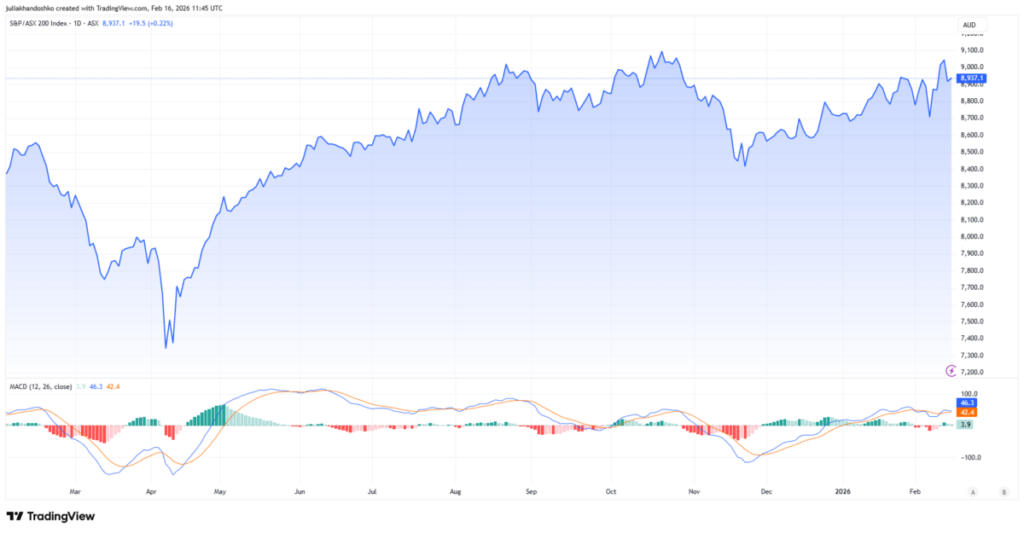
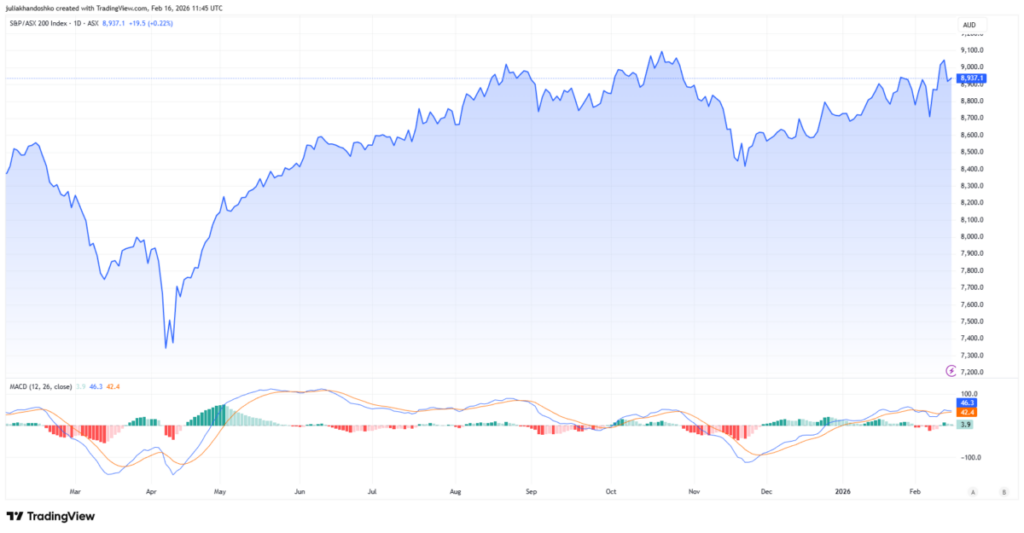
The ASX 200 index, denominated in Australian dollars, has delivered steady growth since 2008 with limited major drawdowns outside the 2020 COVID period. Major banks (such as Commonwealth Bank and National Australia Bank) and resource giants dominate the index weighting. While long-term returns lag behind the S&P 500 even after currency adjustments, the market offers lower volatility, making it appealing for risk-averse investors.
Some individual resource companies-particularly mining giants like BHP ( ASX:BHP ) and Rio Tinto ( ASX:RIO )-often outperform often deliver stronger percentage returns than the broader ASX 200, especially during periods of rising commodity prices. These firms leverage the country’s core advantages in iron ore, gold, and critical minerals. Amid discussions of Australia potentially emerging as a new anglosphere hub, increased capital inflows could enhance the attractiveness of its resource sector and overall market in the coming years.
Benzinga Disclaimer: This article is from an unpaid external contributor. It does not represent Benzinga’s reporting and has not been edited for content or accuracy.
Recent Comments