
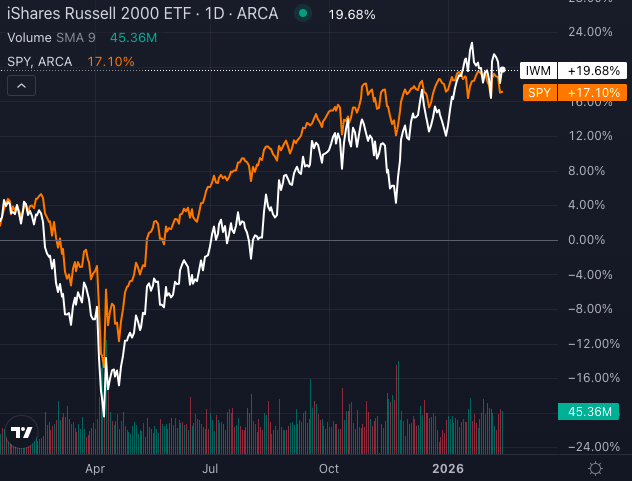
Small-cap stocks are starting to outperform — and historically, that’s been one of the clearest signals a new market cycle is underway. The small-cap stocks-tracking iShares Russell 2000 ETF (NYSE:IWM), which tracks U.S. small-cap stocks, has begun closing its performance gap with the S&P 500-tracking SPDR S&P 500 ETF (NYSE:SPY) after years of underperformance.

Chart created using Benzinga Pro
Since the start of 2021, the S&P 500 gained more than 63%, while the Russell 2000 rose just 18%, according to Benzinga Pro data. That divergence is what pushed small-cap valuations to historically low levels.

Chart created using Benzinga Pro
The Russell 2000 still trades at roughly 16x forward earnings, compared to about 21x for the S&P 500, based on FactSet estimates.
This valuation gap is now attracting institutional attention.
Rate Sensitivity And Domestic Exposure Create Leverage
Small caps are more sensitive to interest rates and domestic economic conditions than large-cap multinationals. With markets increasingly expecting Federal Reserve rate cuts in 2026, financing conditions could improve significantly for smaller companies.
Regional banks, which make up a meaningful portion of small-cap indexes, illustrate this dynamic. The SPDR S&P Regional Banking ETF (NYSE:KRE) remains down more than 35% from its 2022 peak, even as bank balance sheets have stabilized and deposit outflows slowed, according to Federal Reserve data.
Historically, small caps tend to outperform early in economic expansions. Goldman Sachs notes that in the first 12 months following the Fed’s last five rate-cutting cycles, the Russell 2000 outperformed the S&P 500 by an average of 12 percentage points.
Institutional Positioning Remains Underweight
Fund managers remain structurally underweight small caps. Bank of America’s Global Fund Manager Survey shows allocations to U.S. small caps are still below long-term averages, reflecting lingering caution after years of mega-cap tech dominance.
That positioning creates asymmetry. When capital begins rotating, small caps tend to move quickly because they start from lower ownership levels.
Small caps aren’t just another trade. They’re often one of the earliest signals that capital is shifting — and that a new market leadership cycle is beginning.
Recent Comments