
For Mike Musheinesh, CEO of Detroit Axle, the economic effects of President Donald Trump’s import tariff policies arrived like a sledgehammer.
The auto parts retailer’s tariff bill on $1 million of imports skyrocketed from $25,000 to an eye-watering $725,000 overnight. It was a 70% jump that transformed the federal government into Detroit Axle’s single largest business expense.
Facing a $700,000 increase in cost per shipment, Musheinesh had to make a choice. He has avoided layoffs, but the financial pressure was immediate, Musheinesh told Benzinga.
“Prior to the tariff implementation, we initiated cost controls and efficiencies wherever possible. But that can only do so much. Beyond that, unfortunately, the only way to cover those gaps was to increase the sale price of products and reduce our profitability,” he said.

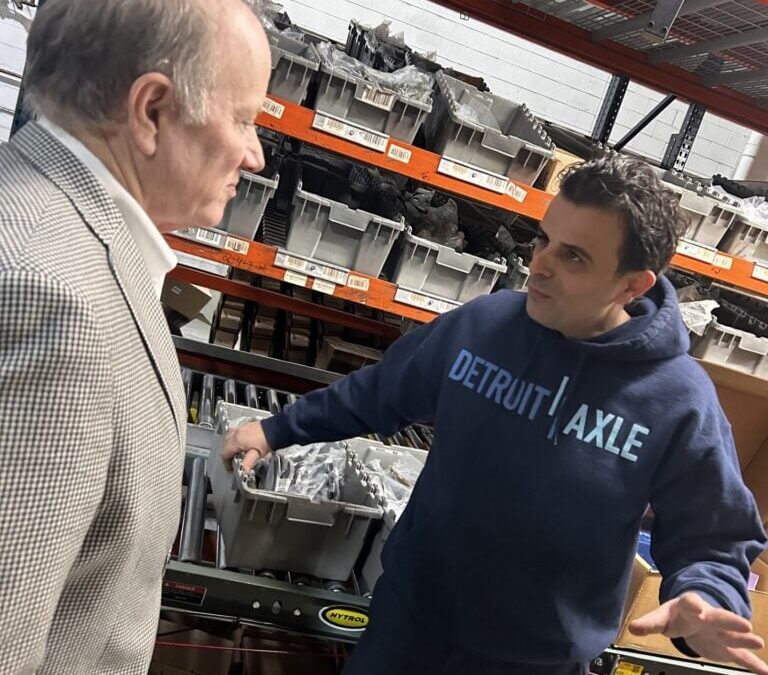
Photo: Mike Musheinesh, CEO of Detroit Axle, speaking with former Detroit Mayor Mike Duggan
The struggle led Musheinesh to the steps of the federal court. His lawsuit, now closely tethered to the high-profile Supreme Court case V.O.S. Selections, challenges the Trump administration’s authority to tax via executive order and the elimination of the de minimis exemption.
Musheinesh joins a wave of large corporations also suing over tariffs, including Costco Wholesale Corp. (NASDAQ:COST) and Target Corp. (NYSE:TGT), both of which have navigated the fallout of the sweeping trade policies.
For Musheinesh, it was about the principles of the free market and the U.S. Constitution.
“I felt the need to file our suit because no one was suing on behalf of the de minimis exemption that was removed. I believe it’s our duty and constitutional right to fight these government actions that are undermining the free market,” he said.
Tariff Collections
U.S. Treasury data shows that tariff collections reached roughly $29 billion in January 2026. While this is triple what was collected a year ago, it is a slight dip from the October 2025 peak, largely due to some country-specific exemptions and trade agreements negotiated by the administration.
Business Impact: Companies such as Detroit Axle continue to operate under a cloud of uncertainty, as the multi-million dollar tariff costs are still being collected while the legality of the tariffs is decided.
What To Watch Next
The Supreme Court’s decision in Learning Resources v. Trump v. V.O.S. Selections is approaching a critical juncture as the justices return from winter recess at the end of February.
Legal experts believe a ruling is likely to be released in the very near future since the case was argued on an expedited basis last November. The court often uses the period immediately following its winter break to hand down opinions for cases heard in the fall.
The most critical date is Monday, Feb. 23, when the court officially returns to the bench. However, the court could release an “Orders List” with an opinion as early as Friday, Feb. 20.

Photo: Mike Musheinesh, CEO of Detroit Axle, speaking with former Detroit Mayor Mike Duggan
Cover Photo: FOTOGRIN from Shutterstock
Recent Comments