
Six House Republicans joined Democrats on Wednesday to pass a resolution aimed at repealing President Donald Trump‘s tariffs on Canada, delivering a bipartisan rebuke to the administration’s hardline trade approach toward one of America’s closest allies.
The House approved the measure by a 219–211 vote, following an intraparty revolt that exposed growing discomfort within the GOP over Trump’s use of tariffs as a negotiating tool.
Rare Bipartisan Vote
Reps. Don Bacon (R-Neb.), Kevin Kiley (R-Calif.), Thomas Massie (R-Ky.), Jeff Hurd (R–Co.), Brian Fitzpatrick (R-Pa.) and Dan Newhouse (R-Wash.) sided with nearly all Democrats in backing the resolution, which was sponsored by Rep. Gregory Meeks (D-N.Y.), the ranking member of the House Foreign Affairs Committee.
The measure would terminate Trump’s use of a national emergency declaration to impose punitive tariffs on Canadian imports. Rep. Jared Golden (D-Maine) was the lone Democrat to vote against it.
Procedural Revolt Paved The Way
Wednesday’s vote followed a failed procedural rule vote on Tuesday, when several Republicans joined Democrats to block language that would have prevented lawmakers from calling snap votes to repeal Trump’s tariffs.
That defeat cleared the path for a series of fast-track repeal votes — beginning with the Canada measure — and signaled a deeper rift within the House GOP over trade policy.
“We have a trade agreement, and I think they’ve been a good ally,” Bacon told The Hill before the vote, adding that Canada had been “unfairly attacked by the administration.”
Massie argued that tariff authority constitutionally belongs to Congress, not the executive branch.
Tariff Tensions With Canada Intensify
The House action comes amid heightened friction between Washington and Ottawa, as Trump has repeatedly escalated pressure on Canada through trade threats and policy actions.
In recent months, Trump has threatened to block the opening of a key Ontario bridge, revoked certifications for Canadian aircraft, and warned of tariffs as high as 50% tied to disputes involving U.S.-made Gulfstream jets.
He has also criticized Canada’s electric vehicle supply chain ties with China and previously scrapped trade talks over a Canadian political ad criticizing tariffs.
Canada has since been expected to announce steps toward certifying U.S.-made Gulfstream aircraft, a move widely seen as an effort to ease tensions, even as broader tariff disputes remain unresolved.
Trump Issues Primary Threats
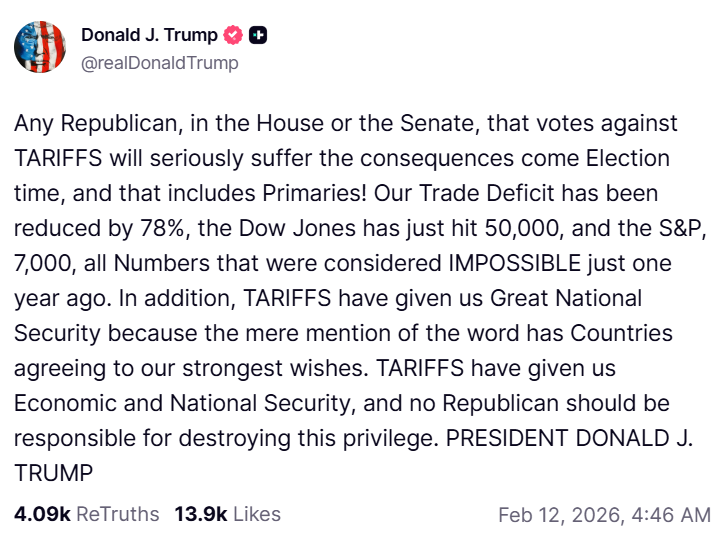
As the House vote wrapped up, Trump took to Truth Social to warn Republican lawmakers who opposed his tariff strategy.

“Any Republican, in the House or the Senate, that votes against TARIFFS will seriously suffer the consequences come Election time, and that includes Primaries!” Trump wrote, claiming tariffs have delivered “Economic and National Security.”
Senate Next, Veto Likely
Meeks praised the six Republicans who broke with party leadership, saying they prioritized their constituents over political pressure. He also blasted Trump’s tariffs on Canada, calling the country “one of our strongest allies.”
The resolution now heads to the Senate, where it is widely expected to pass. In October, four Republican senators — Mitch McConnell, Rand Paul, Susan Collins and Lisa Murkowski — joined Democrats in approving a similar measure terminating Trump’s Canada tariffs.
Trump is expected to veto the bill, but Democrats are likely to highlight the growing bipartisan pushback as evidence that the administration’s tariff strategy is facing increasing resistance — even within the president’s own party.
Disclaimer: This content was partially produced with the help of AI tools and was reviewed and published by Benzinga editors.
Photo courtesy: Evan El-Amin on Shutterstock.com
Recent Comments