
Western Digital is up 970% in a year. Here’s why the real story isn’t about memory chips, but about where AI data lives forever.
Everyone knows about the GPU trade. NVIDIA makes the brains of AI. Micron makes the fast memory those brains think with. These are the names that fill headlines, fill portfolios, and fill analyst reports.
Still, we can’t forget about the warehouse.
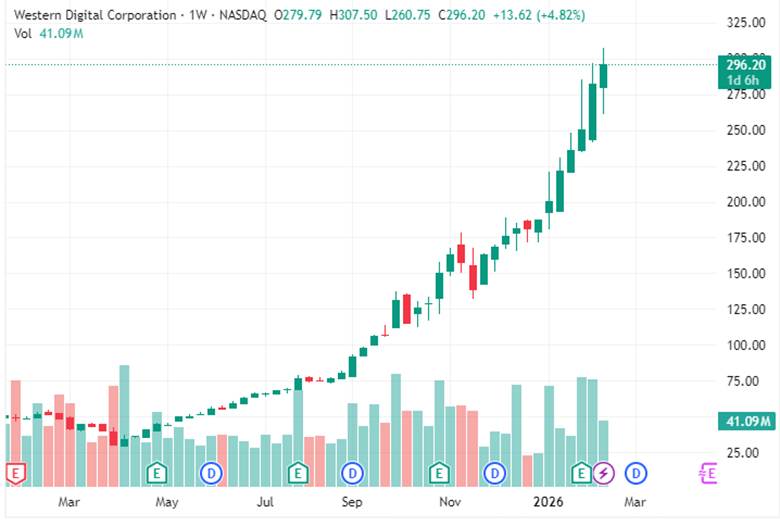
Western Digital (NASDAQ:WDC) hit a 52‑week high of $307 this morning. Less than a year ago, the stock traded as low as $28.83. That’s roughly a 970% gain in 12 months, making it the second-best S&P 500 stock in 2025, trailing only Sandisk (NASDAQ:SNDK) – its own spinoff. Morgan Stanley has a $369 price target on WDC, and BofA just raised theirs to $375.
So what happened? And more importantly, is the story over, or just getting started?
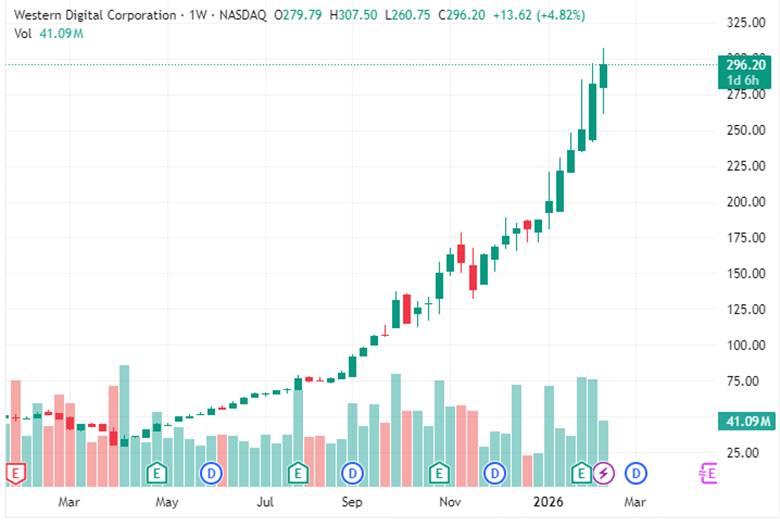
Western Digital (WDC) daily chart through February 12, 2026. The stock surged from $28.83 (April 2025 low) to an intraday high of $307.50, a 970% gain, fueled by AI storage demand, margin expansion, and spin‑off optionality. Note the vertical rally since November 2025, now testing $300 resistance.
AI Has a Storage Problem Nobody Mentions
Think of AI infrastructure like a library. GPUs are the reading room: fast, expensive, loud with activity. DRAM and high-bandwidth memory are the shelves closest to the reader’s chair. But most of the books in any library sit far back in the stacks, rarely touched but absolutely essential. That’s where hard drives live. And right now, those stacks are overflowing.
AI training runs generate enormous amounts of data that can’t be thrown away. Model checkpoints, training logs, raw datasets, fine-tuning sets – all of it needs to sit somewhere cheap between sessions. WD’s CEO told investors that HDDs make up about 80% of storage deployed in hyperscale environments. SSDs are too expensive for this kind of bulk storage. Tape is too slow. Hard drives hit the sweet spot – cheap enough to stack by the petabyte, fast enough to pull data in seconds.
The numbers back this up. WD reported fiscal Q2 2026 revenue of $2.655 billion, shipping 215 exabytes of storage in a single quarter. Gross margins hit 46.1%, up sharply from a year earlier. The company expects full-year fiscal 2026 revenue to roughly double, crossing $12 billion. And it has locked in procurement agreements with its top seven customers for all of calendar 2026, with some deals running into 2027 and 2028.
When your customers are AWS, Microsoft Azure, and Google Cloud, and they’re signing multi-year contracts to lock in supply, that’s not a cyclical hardware story. That starts to look like infrastructure. (One caveat worth keeping in mind: these agreements are capacity reservations, not take-or-pay contracts. Customers can renegotiate terms if demand slows. History shows they do.)
The Technology Bet Most People Miss
WD isn’t just selling the same hard drives it sold five years ago. Now it’s betting on a technology called HAMR – Heat-Assisted Magnetic Recording – that could change the cost structure of AI storage for the rest of the decade.
Right now, WD’s flagship product is a 40TB UltraSMR drive currently in qualification with two hyperscale customers, with volume production planned for late 2026. HAMR drives are next – ramp production in 2027. By 2029, WD is targeting 100TB per drive.
To understand why this is important, think about what it means to pack 100TB onto a single 3.5-inch disk. WD’s engineers are working on laser technology that could increase areal density from 4TB per platter to 10TB per platter by 2028, and fit up to 14 platters into the same form factor. For a hyperscaler building a new data center, that’s a massive shift in how many rack slots they need per petabyte of storage, and how much they spend on power and cooling.
WD also announced new ‘High Bandwidth Drive’ technology that doubles sequential throughput, and a ‘Dual Pivot’ design that will hit the market in 2028 and eventually deliver up to 8x bandwidth gains. A separate power-optimized drive uses 20% less electricity. This is a real selling point for data centers trying to manage energy costs at AI scale.
The smart move here is that WD built HAMR on the same mechanical platform as its existing drives. Hyperscalers can drop HAMR and older ePMR drives into the same rack without changing software or how they manage their storage fleet. That’s not a small thing, it removes one of the biggest reasons enterprise customers drag their feet on new technology.
The Divorce That Created Two Different AI Plays
For years, activist investor Elliott Management pushed Western Digital to split its HDD and flash businesses, arguing the two were dragging each other’s valuations down. The spinoff finally happened in February 2025. WD kept the hard drives. Sandisk (SNDK) took the flash business and relisted as an independent company.
Elliott was right. Sandisk became the best-performing S&P 500 stock in 2025, up 559%. WD came in second at 282%. The combined entity before the split would never have been valued as highly as both parts are today.
But there’s one point most coverage misses: these two stocks now follow different cycles. WD is tied to AI infrastructure capex – when hyperscalers build data centers, WD sells drives. Sandisk is tied to the broader NAND flash cycle, which includes consumer devices, smartphones, and PCs. When NAND supply gets tight (as it is now), Sandisk wins. When it loosens, Sandisk gets hit.
For investors, that creates an interesting pair trade opportunity. You can own WD as a long-cycle AI infrastructure play and short Sandisk if you think the NAND upcycle is near its top. Or, then, do the reverse if you think consumer tech demand is about to pick up. Before the split, you couldn’t make that distinction.
WD also still holds about 5% of Sandisk shares after selling down its initial 19.9% stake. That’s an option on future flash upside that doesn’t show up cleanly in most analyst models.
What the Bulls Are Pricing In
WD’s long-term targets, laid out at its Innovation Day, are bold. Management is guiding for revenue growing at more than 20% per year, gross margins above 50%, operating margins above 40%, and earnings per share above $20. The company also approved a fresh $4 billion share buyback on top of $615 million already completed, bringing total buyback authorization to $6 billion.
Storage exabyte demand is expected to grow at more than 25% per year over the next five years. AI and cloud now account for roughly 90% of WD’s revenue, up from a company where consumer drives once made up a much bigger slice. Institutional ownership has climbed to 92%, as funds that avoided the old conglomerate structure piled in after the spinoff.
This means WD is no longer a cyclical hardware company. It’s a near-monopoly supplier of the cheapest and most scalable form of AI data storage, with multi-year customer contracts, a clear technology roadmap, and margins that look nothing like the company’s history.
What the Bears Are Watching
History has a word for “sold out” storage suppliers: cyclical. The hard drive and flash memory markets have been through boom-bust cycles many times. The last big bust, in 2023, sent WD’s stock below $30 and forced deep losses. The current setup – tight supply, rising prices, multi-year deals – looks different. But similar things were said in 2017 and 2021.
The bear case rests on three things. First, if hyperscalers over-order now to lock in supply, they could end up with surplus drives in 2027 and cancel or delay new orders. That digestion phase has ended prior cycles badly. Second, Seagate isn’t just “pursuing the same HAMR roadmap” – it’s already there. Seagate shipped over one million HAMR drives commercially in 2025 and has qualified its drives at Google. WD’s HAMR ramp doesn’t start until 2027. WD is betting its future on drives that aren’t in production yet, against a rival that already has hyperscale customers buying. Third, the SSD threat isn’t just about price. Meta’s engineering team recently argued that newer flash drives use roughly 80% less power per terabyte than hard drives – and in markets like Northern Virginia and Dublin, where AI data centers are already running out of power, that gap matters more than cost per terabyte alone. HDDs are still five times cheaper per TB, which keeps them dominant for cold storage today. But the pressure is coming from two directions at once: a rival that’s ahead on technology execution, and a power problem that gets harder to ignore every year.
There’s also one detail worth noting. WD’s CEO Irving Tan sold 17,201 shares on February 2nd, cashing in roughly $5.1 million through a pre-set trading plan. Single insider sales under 10b5-1 plans aren’t a red flag on their own – executives sell for many reasons. But at a stock trading near all-time highs, it’s worth keeping in mind.
One more thing retail investors rarely hear: this story has a historical twin. In 2013 and 2014, Seagate and Western Digital were the “cloud storage winners”, with the same narrative, almost word for word. Both stocks rallied hard. Then PC demand fell, SSDs crept into laptops, and exabyte growth slowed just enough to tip the cycle. By 2015, both stocks had given back a large chunk of those gains. The investors who saw it coming weren’t smarter. They were just watching the right numbers: exabyte shipment growth rates, channel inventory levels, and whether management’s pricing language was shifting from “strong” to “competitive.” Those same three signals will likely call the turn in this cycle too, when it comes.
With many analysts covering the stock, the average price target is $265 – about 10% below today’s price of $294. Most analysts are bullish (Buy/Strong Buy consensus), but the consensus target suggests the market has already priced in a lot of good news. Even the bulls see limited room left after the 970% rally
WDC vs. Peers: A Quick Comparison
How WD stacks up against Sandisk (SNDK) and Seagate (NASDAQ:STX) on the key numbers:
| Metric | WD (WDC) | Sandisk (SNDK) | Seagate (STX) |
| Focus | HDD (pure-play) | NAND flash (pure-play) | HDD (pure-play) |
| 1-yr return | +504% | +650% (since Feb ’25 spinoff) | ~+90% |
| Gross margin (latest) | 46.1% | 41–43% (guided) | ~32% (est.) |
| Revenue growth (YoY) | +28% | +23% (Q1 FY26) | ~+20% (est.) |
| Key tech bet | HAMR → 100TB by 2029 | BiCS8 NAND upcycle | HAMR, competing roadmap |
| Avg. analyst target | $265 (below market) | $280 (~4% upside) | N/A (check current) |
| Main risk | AI capex slowdown, Seagate competition | NAND oversupply (2027?) | HAMR execution, no flash optionality |
The Real Test for Western Digital’s AI Story
GPU stocks get the headlines. Hard drives get the data. WD has done something new: it took a commodity hardware business that everyone wrote off, spun out its most volatile division, locked in the biggest cloud companies on long-term supply deals, and built a technology roadmap that keeps HDDs relevant for at least the next five years of AI growth.
The easy money from $29 is gone. At $295, with the average analyst target below the current price, the stock already prices in a lot. What it doesn’t fully price in is the 100TB roadmap, the platform software business WD is quietly building for mid-scale AI customers, and the possibility that AI data creation keeps growing faster than anyone’s models suggest.
The AI trade isn’t just chips. It’s everything that holds the data those chips generate. WD built the warehouse. The question now is whether the rent keeps going up – or whether the next cycle brings it back down.
Disclaimer: This article is for informational and educational purposes only and does not constitute financial or investment advice. All data sourced from: Western Digital Corporation (wdc.com), Morgan Stanley research, BofA Securities, Cantor Fitzgerald, Goldman Sachs. Stock prices as of February 12, 2026. The author has no positions in any securities mentioned.
Benzinga Disclaimer: This article is from an unpaid external contributor. It does not represent Benzinga’s reporting and has not been edited for content or accuracy.
Recent Comments