
Defense stocks have staged one of the most powerful rallies in recent months, and Wall Street says the move may still be in its early innings.
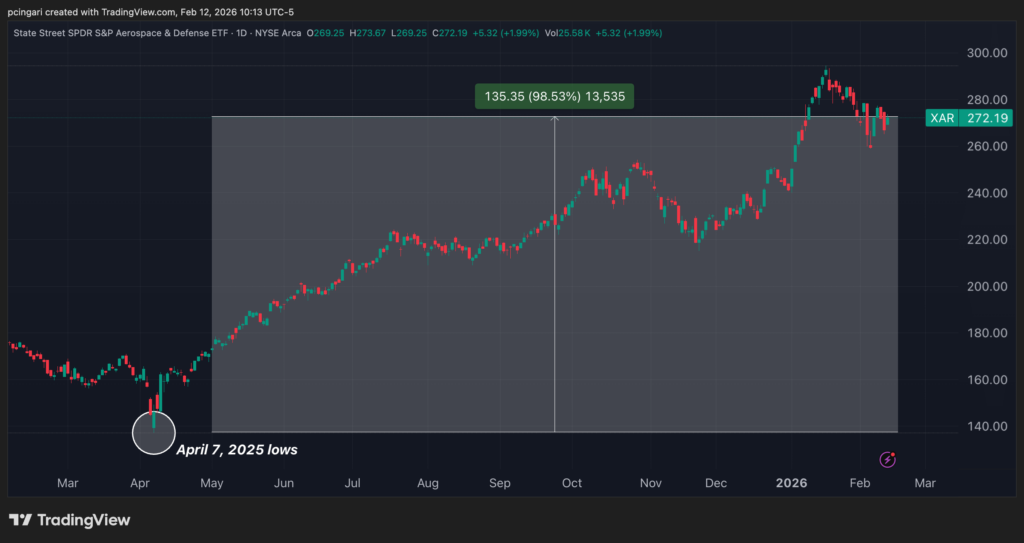
Shares tied to defense contractors – closely tracked by the State Street SPDR S&P Aerospace & Defense ETF (NYSE:XAR) – have rallied by nearly 100% since April 2025 lows.
Only gold miners have posted a stronger rebound over that stretch.
For the defense industry, the current 10-month rolling return now exceeds the surge recorded in the aftermath of March 2009
The question investors now face: has the move gone too far, too fast, or are fundamentals catching up?
Chart: State Street SPDR S&P Aerospace & Defense ETF Up Nearly 100% Since April 2025 Lows
Defense Budgets Are Climbing—Fast
In a note shared Thursday, Bank of America equity analyst Ronald Epstein described the current defense backdrop as a “rise of a new modern age.”
Global defense spending is accelerating.
The U.S. defense budget now exceeds $1 trillion. NATO countries are moving toward spending 3.5% of gross domestic product on core defense by 2035.
If non-U.S. NATO members reach that 3.5% target, spending would increase by roughly $370 billion, according to BofA Global Research.
Epstein sees shipbuilding and air and missile defense systems, including initiatives such as the “Golden Dome,” as key growth areas. Missile and munitions stockpiles remain depleted after years of support for Ukraine and other allies.
The bank expects ‘prime’ contractors such as Northrop Grumman Corp. (NYSE:NOC), RTX Corp. (NYSE:RTX) and L3Harris Technologies Inc. (NYSE:LHX) stand to benefit most.
$1.5 Trillion Budget On The Table?
At a recent Defense Outlook Forum hosted by Bank of America, retired Gen. Arnold Punaro expressed optimism that the U.S. defense budget could grow to $1.5 trillion.
That would represent roughly a 50% increase relative to fiscal 2026 levels.
Not everyone agrees that jump is realistic. Analysts Doug Berenson and Todd Harrison said major top-line growth may be difficult as Congress faces a roughly $42 trillion federal deficit.
Still, the direction of travel appears clear: higher, not lower.
The threat environment remains elevated. Tensions in the Middle East persist. Russia’s war in Ukraine continues. Strategic focus on the Pacific is intensifying.
AI And Automation: The New Battlefield
Future wars will not look like the past. Bank of America highlights the growing importance of automation, autonomy and artificial intelligence across war-fighting domains.
The Department of War is pushing contractors to improve output, lower costs and build an enduring software advantage.
Autonomous systems and enterprise-level AI adoption are becoming non-negotiable.
According to Epstein, defense contractors that integrate AI at both the enterprise and battlefield levels could achieve margins closer to commercial aerospace or technology companies.
Have Defense Stocks Moved Too Far?
A nearly 100% rally in the defense sector naturally raises valuation concerns.
But unlike speculative tech surges driven purely by sentiment, this move appears grounded in fundamentals.
Governments are committing to multi-year budget increases, geopolitical tensions remain elevated across multiple regions, global missile and munitions inventories are depleted, and defense has become a clear policy priority across the U.S. and NATO allies.
Valuations have risen, but earnings estimates are also climbing as backlog grows and capacity expands.
If Bank of America is right, investors may be still witnessing the early phase of a structural upcycle rather than the end of a tactical bounce.
Image: Shutterstock
Recent Comments