
Following Daniel Ek’s transition from the CEO role, Spotify Technology S.A. (NYSE:SPOT) says the company hasn’t changed direction — but it has changed how it operates, with a sharper focus on coordination, execution and planning in the age of artificial intelligence.
Leadership Structure Shift After Daniel Ek
On Tuesday, during Spotify’s fourth-quarter earnings call, Co-CEO Gustav Söderström said the company’s strategy remains intact, but its internal structure has evolved.
With two co-CEOs — Söderström and Alex Norström — at the helm, Spotify opted against splitting the organization into separate power centers. Instead, leadership now runs as a single, unified decision-making body.
“Were we going to sort of split the thing down the middle, manage our own teams, have our own meetings. We decided not to,” Söderström said.
The company holds a weekly three-hour executive session, bringing together its VP and SVP leaders to make decisions and remove bottlenecks.
“We have the entire decision layer of Spotify, sort of the VP/SVP layer, in this room three hours every week, deciding and running and unblocking the entire company,” he said.
He described the shift as a move toward tighter synchronization and more deliberate planning.
Spotify’s AI Strategy: Planning Matters More, Not Less
Söderström also offered a pointed take on how artificial intelligence is reshaping corporate strategy.
“In this age of AI, I think many companies are making a mistake,” he said. “People feel like when you have AI, you don’t need to plan anymore. I think it’s actually going to be the opposite.”
As productivity tools become more powerful, he argued, companies will need clearer priorities and stronger planning to fully leverage AI-driven execution.
Norström added that the operational shift has been underway for more than two years, contributing to 17% compounded revenue growth, 20% gross profit growth and a significant expansion in operating margin.
Spotify Q4 Earnings Beat: EPS Jumps About 75%
Spotify topped Wall Street expectations, posting earnings per share of $5.16 — a 74.92% surprise above the $2.95 consensus estimate.
Revenue increased by $748 million compared with the same quarter a year ago.
Earlier during the call, Norström said the company currently counts 3.5% of the global population as subscribers but sees significant expansion potential.
Price Action: Spotify closed at $476.02 on Tuesday, up 14.75% and rose another 0.44% to $478.11 in after-hours trading, according to Benzinga Pro.
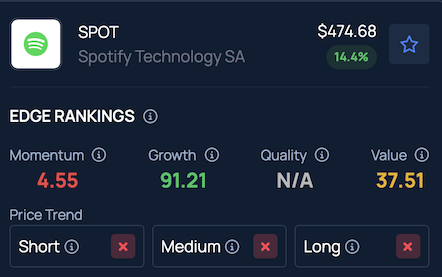
According to Benzinga Edge Stock Rankings, Spotify is showing weak price performance across short, medium and long-term time frames, with low Momentum scores overall.

Disclaimer: This content was partially produced with the help of AI tools and was reviewed and published by Benzinga editors.
Photo courtesy: Diego Thomazini / Shutterstock.com
Recent Comments