
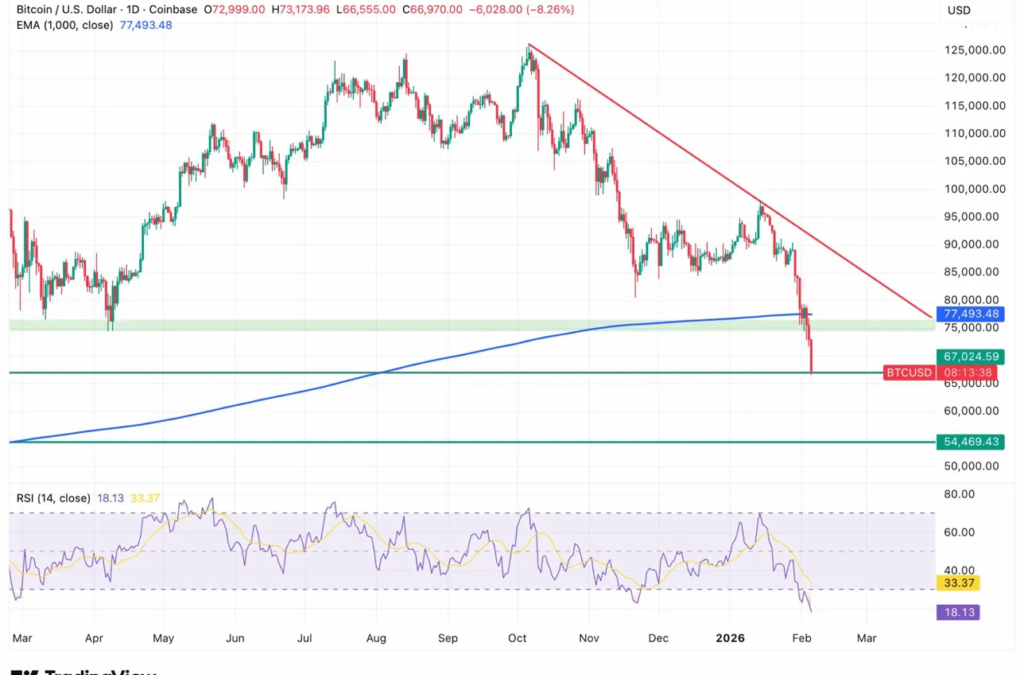
Bitcoin (CRYPTO: BTC) has breaken below the critical 1,000-day exponential moving average for the first time since 2023, as $1.5 billion in net outflows over three days mark one of the most severe selling periods in recent history.
The Historic EMA Break

The 1,000-day EMA has historically acted as major long-term support during bull markets.
Breaking below this indicator signals a potential shift from bull market structure to bear market or deep correction phase.
Historical precedent is clear.
When Bitcoin loses this key moving average, it typically leads to extended consolidation or further downside.
Any bounce attempts face immediate resistance at $77,493 where the 1,000-day EMA now sits.
The Capital Flight
Spot data reveals catastrophic capital flight. $399.63 million in outflows occurred on February 5 alone, bringing total net outflows to approximately $1.5 billion over three days.
What began as profit-taking snowballed into forced liquidations.
The stalled Clarity Act left regulatory uncertainty hanging, while the AI boom and metals rally drew capital away from crypto.
The Critical Support Tests
Bitcoin tests the support zone around $67,000-$75,000, a critical demand area.
Immediate support sits at $67,024, currently being tested.
If this zone fails, next major support doesn’t appear until $65,000-$66,000, followed by $54,469.
A breakdown triggers panic selling toward these lower levels.
The RSI at 18.13 shows Bitcoin in deeply oversold territory—levels rarely seen. RSI below 20 indicates severe selling exhaustion and potential for a technical bounce.
The Contrarian Whale Signal
Bitfinex margin long positions have climbed to roughly 77,100 BTC—the highest level since December 2023 when Bitcoin traded near $40,000 according to Coindesk.
Margin longs are up 64% over the past six months as Bitcoin fell nearly 50% from its October all-time high.
This suggests a large whale is buying into the correction. Historically, Bitfinex margin longs act as a contrarian indicator, expanding during market stress and narrowing when prices rise.
However, the growing position may indicate Bitcoin hasn’t found a definitive bottom yet.
At previous cycle lows around the FTX collapse in November 2022, the August 2024 carry-trade unwind, and April 2025’s tariff tantrum, margin long exposures held near peak levels as prices bottomed out—but only after reaching extremes first.
Image: Shutterstock
Recent Comments