
Gold and silver are teaching a hard lesson to a generation of investors raised on tech stocks, meme names and digital coins.
Over the past 12 months, gold has rallied roughly 95%, while silver has surged more than 270% — moves more commonly associated with high-flying cryptocurrencies than with metals often dismissed as relics or old-fashioned.
In sheer scale, the rally is even more striking. Gold and silver now command a combined market capitalization of roughly $43 trillion — with gold at nearly $37 trillion and silver above $6 trillion — ranking as the first and second largest assets in the world by market value.
By comparison, Bitcoin (CRYPTO: BTC) ranks 10th, with a market capitalization near $1.6 trillion.
Veteran Wall Street investor Ed Yardeni posed an ironic question in a Thursday note: “Is gold the new Bitcoin?”
The tape suggests another one: Is silver too?
The contrast with Bitcoin is where the metals rally looks most unforgiving, as markets seem to reaffirm who truly leads when trust in traditional monetary systems breaks down.
Bitcoin vs. Metals: A Brutal Comparison
World’s Biggest Assets By Market Cap As Of January 29, 2026
| Rank | Name | Market Cap | Price |
|---|---|---|---|
| 1 | Gold | $36.990 T | $5,320 |
| 2 | Silver | $6.349 T | $112.79 |
| 3 | NVIDIA Corp. (NASDAQ:NVDA) | $4.608 T | $189.29 |
| 4 | Alphabet Inc. (NASDAQ:GOOGL) | $4.025 T | $333.47 |
| 5 | Apple Inc. (NASDAQ:AAPL) | $3.788 T | $256.39 |
| 6 | Microsoft Corp. (NYSE:MSFT) | $3.155 T | $424.56 |
| 7 | Amazon.com Inc. (NASDAQ:AMZN) | $2.560 T | $239.53 |
| 8 | Meta Platforms (NASDAQ:META) | $1.844 T | $731.96 |
| 9 | TSMC (NASDAQ:TSM) | $1.748 T | $337.06 |
| 10 | Bitcoin | $1.699 T | $85,199 |
Bitcoin Tumbled In Gold And Silver Terms
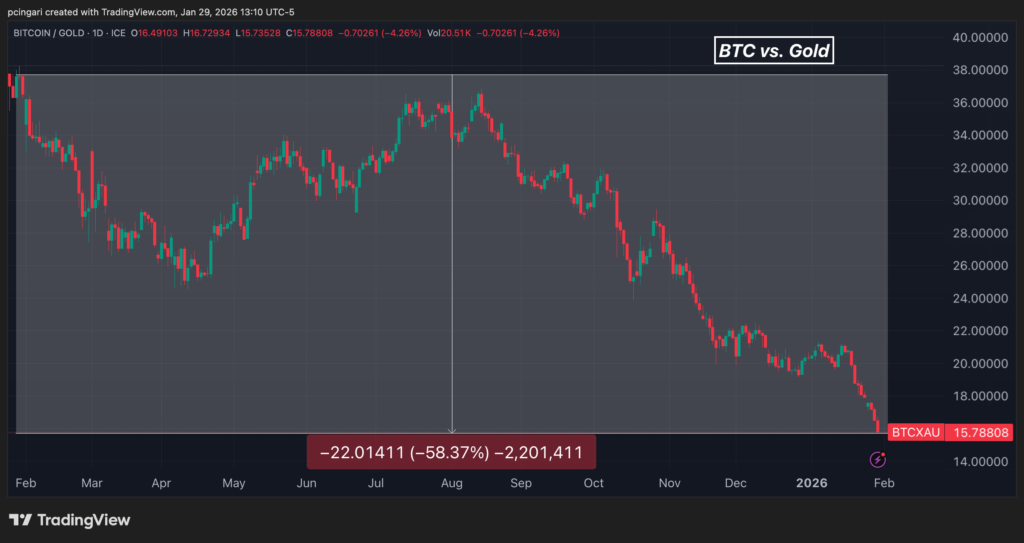
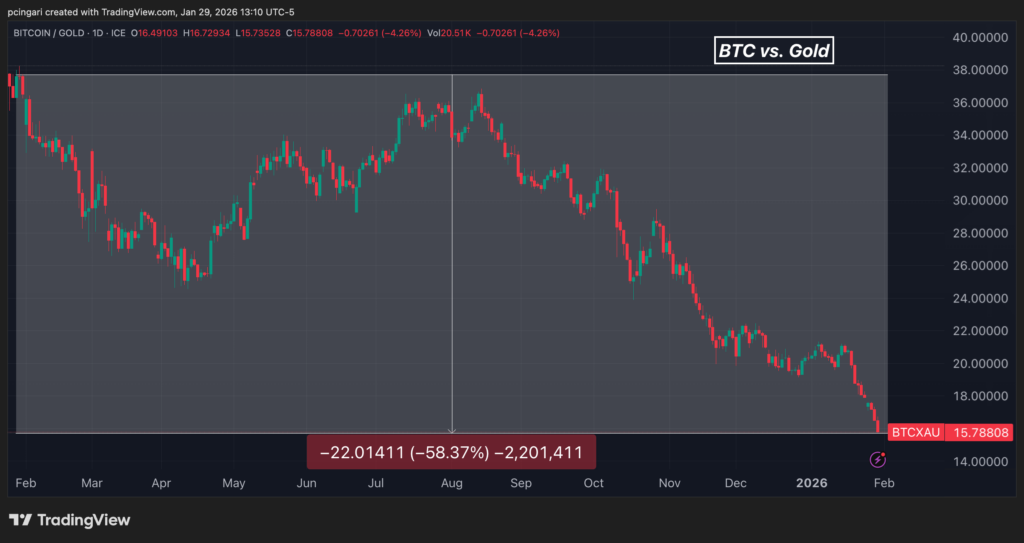
A year ago, one bitcoin could buy about 38 ounces of gold. Today, it buys fewer than 16.
That is a 58% collapse in gold terms.
Against silver, the picture looks even harsher.
In January 2025, one bitcoin bought roughly 3,350 ounces of silver. Today, it buys about 731.
That’s a 79% collapse in silver terms.
Those figures alone should give investors pause.
But the real question isn’t just how much gold and silver have risen compared to Bitcoin — it’s why they have done so.

A Monetary Moment Of Historic Proportions
Beyond the numbers themselves lies the real question: why has this paradigm shift occurred now?
The answer sits at the intersection of fiscal excess, political pressure and eroding monetary credibility.
U.S. national debt has climbed to $38.7 trillion as of late January, against a GDP of roughly $31 trillion, pushing the debt-to-GDP ratio to 122%, among the highest in the world.
The problem is that the exorbitant privilege of printing the world’s reserve currency is fraying, as global central banks — the system’s core demand base — increasingly choose gold over dollars.
In Washington, there is no sign of spending restraint.
According to the Treasury Department, fiscal year 2025 spending totaled $7.01 trillion. Revenue reached $5.23 trillion. The result was a $1.78 trillion deficit.
From October 2025 through January 2026, just four months into the new fiscal year, the deficit has already exceeded $600 billion.
At this pace, fiscal 2026 points back toward another $1.8 trillion gap.
Deficits, at this point, are no longer temporary — they are structural.
Easy Money And The Interest Trap
When fiscal holes widen this fast, the temptation is always the same: force easier monetary conditions.
As Washington bleeds cash, pressure is building at the source.
The Trump administration appears to be attempting an increasingly dangerous maneuver: forcing more liquidity by pushing for lower interest rates on its debt.
The Federal Reserve has already cut rates by 175 basis points since September 2024, and by 75 basis points since September 2025.
Yet even that has not been enough.
The true core of the U.S. deficit has become interest expense – the cost the Treasury pays on its loans and bonds.
In fiscal year 2025 alone, interest payments totaled $1.2 trillion, the highest on record, as the average interest rate paid by the Treasury climbed to 3.3%.
By January 2026, the Treasury has already paid roughly $300 billion in interest, nearly half its annual shortfall.
This is the backdrop against which President Donald Trump’s repeated attacks on Fed Chair Jerome Powell should be read — not as a personal feud, but as a desperate demand for relief from a system under fiscal strain.
The problem is that easy money doesn’t cure the disease — it makes the patient weaker.

Political Pressure And A Fragile Fed Added Fuel To The Fire
The situation escalated further on Jan. 11 when the Department of Justice served the Federal Reserve with grand jury subpoenas, threatening criminal charges related to Powell’s testimony before the Senate Banking Committee last June regarding renovations of historic Fed buildings.
Powell was explicit in his response: “This is not about my testimony or the renovation project. It is a consequence of the Federal Reserve setting interest rates based on what serves the public, rather than following the preferences of the President.”
And more starkly: “This is about whether the Fed will continue to set policy based on evidence and economic conditions — or whether monetary policy will be directed by political pressure or intimidation.”
How the standoff between Powell and the DOJ ultimately ends remains uncertain. But markets appear increasingly focused on the calendar: Powell’s term expires in May, and expectations are building that his successor will be more receptive to presidential pressure.
Those expectation matters. Gold and silver are responding to the fear of lost monetary independence.
Why Gold And Silver Step Forward — And Bitcoin Steps Back
And this is where gold and silver re-enter the frame, while Bitcoin quietly exits the stage.
For years, Bitcoin was framed as an inflation hedge — a status built on the perception of scarcity created by its fixed supply of 21 million coins.
But when the real test became a loss of confidence in the Federal Reserve itself, that narrative cracked.
When Bitcoin and crypto investors needed a loud signal — a rally that screamed monetary distrust — the world’s biggest digital currency didn’t just stay flat.
It fell.
In January alone, Bitcoin is down 4%, on track for its fourth consecutive monthly decline, the longest losing streak since 2019.
Gold, meanwhile, is up 28% — its best monthly performance since 1973.
Silver has surged 60% — its strongest month since 1864, during the U.S. Civil War.
These dates are not coincidences. 1973 marked the collapse of Bretton Woods. 1864 marked the moment when paper money issued to finance the war reached a breaking point.
History doesn’t repeat, but it often rhymes.
When confidence in money begins to crack, markets reach for the same old anchors — regardless of technological progress.
Gold and silver respond to crises of monetary credibility.
Bitcoin responds to something else entirely. And for that trade, markets will need a different story.

Image created using artificial intelligence via Gemini.
Recent Comments