
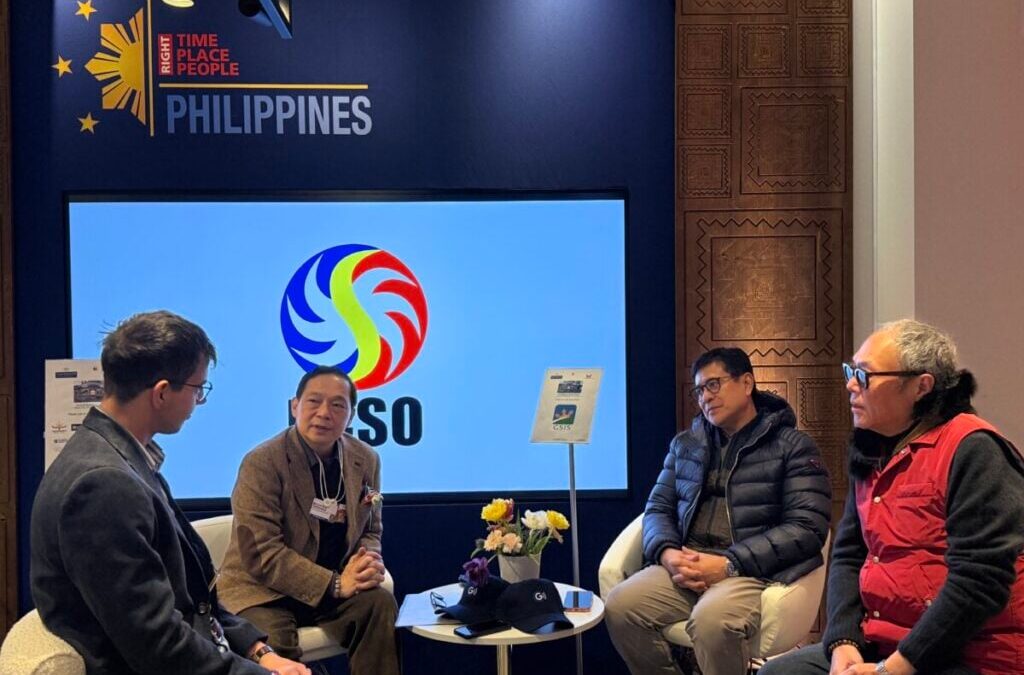
Davos 2026 had a distinctly different atmosphere.
For decades, the World Economic Forum at Davos was a venue for national delegations. This year, it was clear from my on-the-ground perspective that showing up is no longer enough for potential power players. Instead, they constructed Houses; full-scale national platforms designed to host influential stakeholders, share their development stories, and attract investment.
The Philippines, Nigeria, and Poland each expanded their presence at Davos in distinct ways – from iconic receptions with Grammy-winning artists to debates about unprecedented megaprojects.
What follows is a comparison of their playbooks and the implications for the future of economic diplomacy.
The Philippines is Racing Toward 2040

The Philippines’ first-ever House in Davos was a top-down initiative, opened by President Bongbong Marcos and led by government and investment professionals, including Manuel A.J. Teehankee and Andrew Gan.
Teehankee, Permanent Representative to the WTO, shared a clear vision:
“We launched Ambition 2040 to double down on our 5% growth and demographic dividend, and graduate from our recently-achieved middle-income status to a developed country and $1.5 trillion GDP by 2040”.
As Gan, Managing Director of the Philippines-based Beacon Holdings, tells us, the South Asian nation is investing in infrastructure, digitalization, and ease of doing business, leveraging ASEAN’s growing integration as a force multiplier.
Where the Philippines stands out is its financial markets. Even though FDI decreased in 2025, primarily driven by a decline in debt instruments, equity capital inflows rose by 17%. Drawing my background in cross-border M&A, we recognize that the transition to long-term equity conviction signals the market’s increased maturity, further reinforced by the global deployment of sovereign and pension capital and overseas investment mandates.
The House welcomed Nobel laureate Michael Spence and WTO Director General Ngozi Okonjo-Iweala, along with panels about the intertwined roles of government and private capital in urban megaprojects. All crowned by a pop performance by the Black Eyed Peas, positioning the House as a vibrant social center of Davos, with even higher expectations for next year.
Nigeria Has Arrived, Inspired by Its Diaspora

Nigeria’s house told a very different story.
As Collins Nzekwe, the Co-Lead of the Nigeria House, tells us, the pavilion is initiated by WEF veterans, most of whom are from either the American or British diaspora.
“Every year we come to Davos. We hover around. We go to other houses. Why wouldn’t we have our own?” says Collins Nzekwe.
Nzekwe understands Davos as an investment marketplace that the state can catalyze. For context, India reports attracting $4 billion of foreign direct investment (FDI) each year in Davos. Nigeria, with a current GDP of around $300 billion and growth near 4%, aims to boost its visibility to achieve comparable results.
“The essence of Davos is attracting FDI. If you don’t set yourself up for success, nobody is going to come….By 2030, Nigeria is targeting a $1 trillion GDP,” Mr. Nzekwe commented.
The primary catalyst of Nigeria’s rise could be its diaspora, increasingly returning home. According to Nzekwe, investors have noticed the momentum.
“People were coming in and out: How do we enter Nigeria? Our house generated much excitement. And we can’t wait to return in 2027.“
Add to that the decorations and cultural firepower (Diplo performing didn’t hurt), and the message was unmistakable: Nigeria has arrived.
Three Presidents, Three Blue Chips: The European Growth Leader’s Next Leap
“Poland is a country that consistently grows the fastest in Europe, was invited to join the G20, and adapted to crisis after crisis without losing momentum. Yet it needs a twist to start playing first fiddle. That is why we have launched the Leaders Forum,” says Adrianna Śniadowska, CEO at THINKTANK, and Lead Organizer of the Leaders Forum.
The mission behind the house is to position Poland as a rising global player. Autopay, Żabka Group, and Adamed Pharma, three Founding Partners from three different sectors, payments, convenience retail, and pharma, have each expanded internationally, and each represents a distinct industry in which Poland excels.
Together, they show that Poland is no longer just a go-to manufacturing destination. Still, a leading hub with real visions for “the New Europe”, as Jan Bartkowiak, the Co-Organizer of the Forum, calls it.
The political signal matched the economic one. The Forum hosted three Presidents (the serving Karol Nawrocki, and two former, Aleksander Kwaśniewski and Andrzej Duda), alongside the Foreign Minister Radosław Sikorski, and the Finance Minister Andrzej Domański. Leaders came from both sides of the political spectrum, demonstrating broad support for the Forum, and, increasingly, a new national narrative.
Poland’s Davos presence, reinforced by the Polish Business Hub pavilion, speaks to its broader ambitions. The country co-founded the Three Seas Initiative, the north–south axis linking the Baltic, Adriatic, and Black Seas. In Europe, as it rethinks energy security and supply chains, Poland is becoming a key logistics hub, driven by the development of seaports and Port Polska – the largest infrastructure project in Poland’s history.
Looking ahead, I expect Poland’s public-private cohesion around its Davos presence to continue, and for the Leaders Forum to cement itself as a hub that reinvigorates Europe’s image, with more partner states and companies.
The Houses of Tomorrow
All houses reveal the same insight – Davos is no longer a forum to attend, but an infrastructure to develop. Three rising powers, the Philippines, Nigeria, and Poland, all use their Davos Houses as new vehicles to anchor major events and investor relationships.
It goes without saying, then, that more and more countries, such as Israel – with strong representation at the World Economic Forum – are planning to inaugurate their houses in 2027.
Ariel Cohen, Founder of the Israel House Davos stated: “this is a meaningful and timely step in strengthening Israel’s presence within the global dialogue at the World Economic Forum. With the support of the Israeli Ministry of Foreign Affairs, this initiative is designed to serve as a platform for constructive engagement, showcasing Israel’s innovation, resilience, and commitment to collaboration across sectors.”
In a sense, the Davos House is becoming “a Demo Day for nations”, with winners emerging as hosts to the world’s most sophisticated capital allocators. Davos itself is being reshaped, from a forum of a few high-level players, into a global village full of rising powers, eager to pitch the best they have to offer in their own rooms.
**
The article was co-authored by Jan Bartkowiak
Jan Bartkowiak is the Founder & President of Econverse, Poland’s leading youth education and economic policy platform, backed by Microsoft, Amazon, and the Ministry of Digital Affairs. He was selected as a Forbes 30 Under 30 honoree and a Schwarzman Scholar. Jan holds a Bachelor of Science in Social Sciences from Minerva University, having studied across seven global cities in four years. He is currently a graduate student at Schwarzman College, Tsinghua University in Beijing. He is also a Co-Organizer of the Leaders Forum powered by Poland in Davos.
credit for images: Authors
Benzinga Disclaimer: This article is from an unpaid external contributor. It does not represent Benzinga’s reporting and has not been edited for content or accuracy.
Recent Comments