
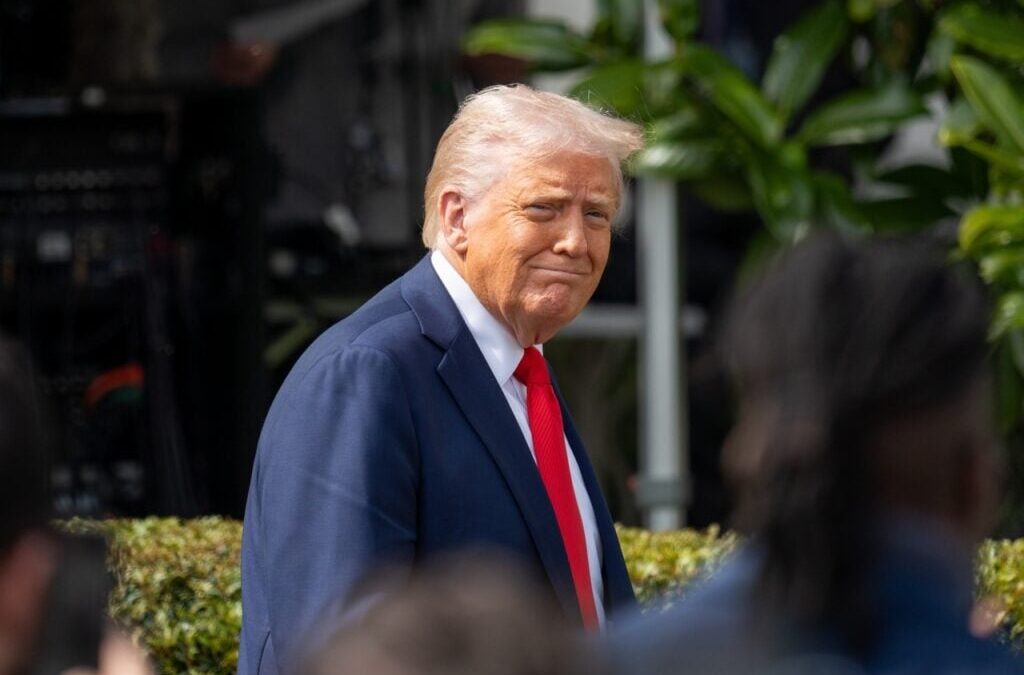
President Donald Trump escalated trade pressure on South Korea by raising tariffs to 25%, a move that risks tightening one of the most fragile corners of global supply chains: memory chips.
In a statement posted Tuesday, Trump said South Korea’s legislature failed to approve a trade agreement reached on July 30, 2025, and reaffirmed during his October visit to the country.
“Our Trade Deals are very important to America,” Trump wrote.
Trump said South Korea’s National Assembly has not enacted the agreement, prompting the tariff increase on autos, lumber, pharmaceuticals, and other reciprocal categories from 15% to 25%.
South-Korea Stocks Surge To Records
South Korean equities didn’t retreat. They surged.
The iShares MSCI South Korea ETF (NYSE:EWY) was up over 3% during Tuesday’s early morning trading in New York.
Shares of Samsung Electronics closed up 4.9% in Seoul on Tuesday, while SK Hynix surged 8.7%, both breaking record highs.
Over the past year, Samsung is up more than 200%, while SK Hynix has climbed over 300%.
Both companies sit at the center of a historic memory-chip crunch, a supply shock that has also lifted shares of Micron Technology Inc. (NASDAQ:MU), Seagate Technology Holdings plc (NASDAQ:STX), SanDisk Corp. (NASDAQ:SNDK), and Western Digital Corp. (NASDAQ:WDC).
The iShares MSCI South Korea ETF has surged 120% over the past year and is already up nearly 25% year to date, ranking among the strongest-performing U.S.-listed country ETFs worldwide, according to CountryETFTracker.com.
The rally has been fueled by an unprecedented squeeze in the global memory market. Memory chips, once a deflationary component for electronics, have become a bottleneck as artificial intelligence infrastructure consumes vast amounts of supply.
Industry data shows DRAM prices up about 171% year over year, with DDR5 spot prices quadrupling since September 2025.
Chart: South Korean Equities Crushed Wall Street Over The Past Year

Memory Shortage Could Last Years
Industry analysts say the shortage differs from past cycles and expect it to persist for the coming years.
Sassine Ghazi, CEO of chipmaker Synopsys Inc. (NASDAQ:SNPS), told CNBC this week that the chip crunch will continue through 2026 and 2027.
Trump’s tariff move adds a geopolitical wildcard to an already strained system. Higher U.S. tariffs risk increasing costs for downstream industries dependent on Korean components.
For U.S. corporations and IT buyers, the consequences are immediate. Elevated memory prices are pushing up device costs, delaying server rollouts and complicating budget planning.
In a market already defined by scarcity, trade friction threatens to make an expensive problem even harder to manage.
Image via Shutterstock/ Joey Sussman
Recent Comments