
In the fast-paced and cutthroat world of business, conducting thorough company analysis is essential for investors and industry experts. In this article, we will undertake a comprehensive industry comparison, evaluating Tesla (NASDAQ:TSLA) in comparison to its major competitors within the Automobiles industry. By analyzing crucial financial metrics, market position, and growth potential, our objective is to provide valuable insights for investors and offer a deeper understanding of company’s performance in the industry.
Tesla Background
Tesla is a vertically integrated battery electric vehicle automaker and developer of real world artificial intelligence software, which includes autonomous driving and humanoid robots. The company has multiple vehicles in its fleet, which include luxury and midsize sedans, crossover SUVs, a light truck, and a semi truck. Tesla also plans to begin selling a sports car and offer a robotaxi service. Global deliveries in 2024 were a little below 1.8 million vehicles. The company sells batteries for stationary storage for residential and commercial properties including utilities and solar panels and solar roofs for energy generation. Tesla also owns a fast-charging network and an auto insurance business.
| Company | P/E | P/B | P/S | ROE | EBITDA (in billions) | Gross Profit (in billions) | Revenue Growth |
|---|---|---|---|---|---|---|---|
| Tesla Inc | 297.54 | 17.94 | 15.90 | 1.75% | $3.66 | $5.05 | 11.57% |
| Toyota Motor Corp | 10.19 | 1.25 | 0.95 | 2.54% | $1824.36 | $1968.84 | 8.15% |
| General Motors Co | 15.44 | 1.14 | 0.43 | 1.95% | $5.74 | $3.11 | -0.34% |
| Ferrari NV | 32.48 | 13.68 | 7.36 | 10.42% | $0.67 | $0.88 | 7.4% |
| Ford Motor Co | 11.77 | 1.16 | 0.29 | 5.29% | $3.67 | $4.3 | 9.39% |
| Li Auto Inc | 14.73 | 1.56 | 0.84 | -0.86% | $-0.71 | $4.47 | -36.17% |
| Thor Industries Inc | 22.30 | 1.45 | 0.64 | 0.5% | $0.11 | $0.32 | 11.5% |
| Winnebago Industries Inc | 37.73 | 1.10 | 0.47 | 0.45% | $0.03 | $0.09 | 12.32% |
| Workhorse Group Inc | 0.06 | 1.38 | 0.32 | -28.77% | $-0.01 | $-0.01 | -4.97% |
| Average | 18.09 | 2.84 | 1.41 | -1.06% | $229.23 | $247.75 | 0.91% |
Upon a comprehensive analysis of Tesla, the following trends can be discerned:
-
At 297.54, the stock’s Price to Earnings ratio significantly exceeds the industry average by 16.45x, suggesting a premium valuation relative to industry peers.
-
With a Price to Book ratio of 17.94, which is 6.32x the industry average, Tesla might be considered overvalued in terms of its book value, as it is trading at a higher multiple compared to its industry peers.
-
The stock’s relatively high Price to Sales ratio of 15.9, surpassing the industry average by 11.28x, may indicate an aspect of overvaluation in terms of sales performance.
-
The Return on Equity (ROE) of 1.75% is 2.81% above the industry average, highlighting efficient use of equity to generate profits.
-
The company has lower Earnings Before Interest, Taxes, Depreciation, and Amortization (EBITDA) of $3.66 Billion, which is 0.02x below the industry average. This potentially indicates lower profitability or financial challenges.
-
With lower gross profit of $5.05 Billion, which indicates 0.02x below the industry average, the company may experience lower revenue after accounting for production costs.
-
The company’s revenue growth of 11.57% is notably higher compared to the industry average of 0.91%, showcasing exceptional sales performance and strong demand for its products or services.
Debt To Equity Ratio

The debt-to-equity (D/E) ratio helps evaluate the capital structure and financial leverage of a company.
Considering the debt-to-equity ratio in industry comparisons allows for a concise evaluation of a company’s financial health and risk profile, aiding in informed decision-making.
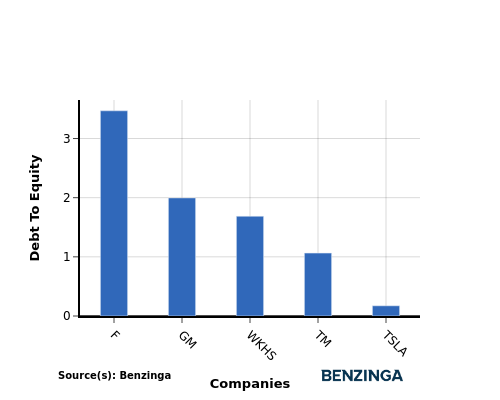
By considering the Debt-to-Equity ratio, Tesla can be compared to its top 4 peers, leading to the following observations:
-
Compared to its top 4 peers, Tesla has a stronger financial position indicated by its lower debt-to-equity ratio of 0.17.
-
This suggests that the company relies less on debt financing and has a more favorable balance between debt and equity, which can be seen as a positive attribute by investors.
Key Takeaways
For Tesla, the PE, PB, and PS ratios are all high compared to its industry peers, indicating that the stock may be overvalued based on these metrics. On the other hand, Tesla’s high ROE and revenue growth suggest strong performance and potential for future growth compared to its peers. However, the low EBITDA and gross profit numbers may raise concerns about the company’s operational efficiency and profitability in the Automobiles industry.
This article was generated by Benzinga’s automated content engine and reviewed by an editor.
Recent Comments