
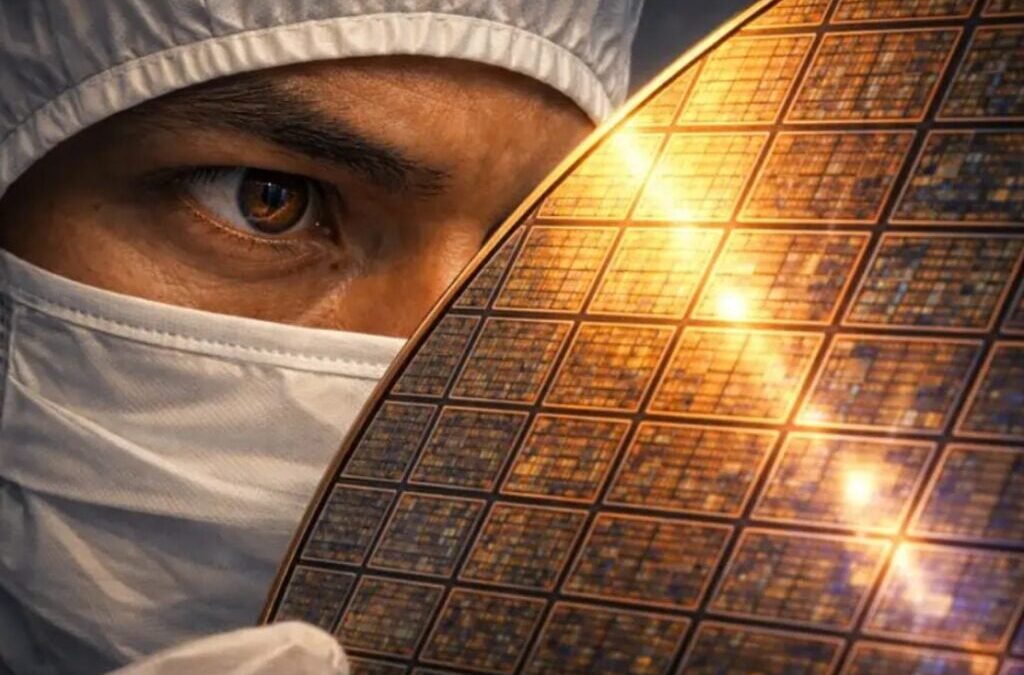
As AI and semiconductors become national priorities, markets are already positioning for how China’s 15th Five-Year Plan will reshape its industrial landscape

Image Credit: Bamboo Works
Not every industry filled prioritized for development in China ultimately survives tensions between policy support and commercial reality. Some sectors gradually lose momentum due to weakening demand, rising costs, or flawed business models, eventually fading from both policy narratives and capital allocation priorities.
With such a reality as backdrop, a key question is not only which industries will be written into policy documents as attention shifts to China’s new 15th Five-Year Plan, but which ones are actually capable of making it to the finish line.
AI self-reliance: Computing power and chips take the lead
In the current policy environment, AI is no longer being positioned as a standalone growth industry. Instead, it is repeatedly framed as a capability that must be deeply integrated with manufacturing, energy systems and the real economy, with an emphasis on developing industry- and industrial-grade large models.
This language effectively elevates demand for computing power from a discretionary corporate choice to an institutionalized form of foundational demand.
Optical communications have emerged as the most representative beneficiary. Over the past year, demand from AI data centers for 800G and 1.6T high-speed optical modules has driven leading companies in the segment to outperform the broader market.
Shares of Zhongji Innolight (300308.SZ) have surged 389.7% over the past year, with its market capitalization approaching 700 billion yuan ($100 billion), while Eoptolink Technology (300502.SZ) jumped 320%. That’s made optical components one of the strongest-performing segments in the AI supply chain among companies listed on China’s domestic markets in Shanghai and Shenzhen.
In semiconductors, policy priorities have similarly shifted from “comprehensive substitution” toward “deployable capability.”
Demand for mature-node processes as well as industrial and automotive chips has put SMIC (0981.HK; 688981.SH) back onto investor radars. Its shares have risen about 80% over the past year, keeping it among the most valuable semiconductor names in China.
The AI segment, by contrast, has shown far sharper divergence. Advanced chipmaker Cambricon Technologies (688256.SH) has gained more than 110% over the past year, driven by demand for industry-specific models and inference workloads — an indication that capital markets are increasingly pricing in the strategic role of computing power.
Biren Technology (6082.HK), recently listed in Hong Kong as China’s first domestically developed GPU company to go public, saw its IPO oversubscribed by about 2,363 times. Its shares are up roughly 7% since the listing, with investors remaining broadly optimistic about its prospects.
Large models as platforms: Valuation divergence
As model capabilities gradually converge, market attention has shifted from asking which model is the strongest to identifying who can offer a scalable AI platform. In China, competition in large models is moving away from startups toward major internet platforms.
Baidu (BIDU.US; 9888.HK), with its Ernie model, and Alibaba (BABA.US; 9988.HK), with Tongyi Qianwen, continue to enjoy high technical visibility, but investors are clearly less impressed. Baidu’s share price and valuation multiples remain depressed, reflecting investor skepticism over whether AI can meaningfully lift its core advertising and cloud businesses. Alibaba’s shares have rebounded, but its valuation recovery remains constrained by limited visibility into cloud profitability.
By contrast, Tencent (0700.HK) has delivered the most stable market performance. Rather than emphasizing model rankings, Tencent has embedded AI capabilities across its gaming, advertising and enterprise services. Its shares have risen more than 50% over the past year, maintaining its position as China’s most valuable technology company.
This suggests investors are more willing to pay for AI narratives that clearly enhance cash flow quality.
The rise of AI agents: From deployment to monetization
More telling than the models themselves is the gradual emergence of AI agents. Unlike general-purpose conversational models, agents are designed to operate continuously within specific scenarios, proactively handling research, analysis, content generation and workflow coordination. This marks a shift from AI as a support tool to AI as an embedded component of real-world workflows.
This trend has already begun to materialize in the Chinese market.
ByteDance’s Doubao, for example, is being integrated into content creation, data organization, and enterprise use cases. The goal is to internalize AI capabilities into reusable work modules, serving as foundational tools to boost organizational and content production efficiency.
This contrast also highlights differing AI development paths between China and the U.S. American tech giants continue to double down on frontier model capabilities, while China places greater emphasis on rapid deployment and monetization.
In late December, Meta (META.US) announced a deal to acquire Manus, a Chinese AI agent company. Such a move underscores the practical advantages of China’s AI ecosystem, which prioritizes rapid deployment and early monetization, while also opening up new possibilities for the future development of domestic AI agent companies.
Robotics and power systems: Efficiency as a structural necessity
If AI computing power and large models form the foundation of the digital economy, then robotics and power systems are increasingly becoming the infrastructure that supports the current wave of upgrades. Unlike earlier phases that emphasized technological demonstrations, both policymakers and markets are now focused on which systems can generate measurable and replicable productivity gains in real-world applications.
In the robotics sector, a key development has been the rise of the robotics-as-a-service (RaaS) model. By adopting leasing arrangements or usage-based pricing, RaaS converts large upfront capital expenditures into predictable operating expenses, significantly lowering barriers to adoption for enterprises.
According to Counterpoint Research, global installations of humanoid robots are expected to reach approximately 16,000 units in 2025, with Chinese companies occupying the top three positions by market share — namely Zhiyuan Robotics, Unitree Robotics, and Ubtech (9880.HK). Cumulative installations are projected to exceed 100,000 units by 2027, with primary applications in logistics, manufacturing and the automotive sector — scenarios where RaaS models are most likely to generate cash flow.
Among these companies, Ubtech’s stock price has risen by more than 135% over the past year. Other players, such as industrial automation firms Inovance Technology (300124.SH) and Estun Automation (002747.SZ), have also gained roughly 30% over the same period.
Some market observers caution that valuation bubble risks in robotics and embodied intelligence could emerge even faster than in AI itself. This serves as a reminder that beyond high-growth expectations, investors should pay close attention to companies’ actual commercialization progress and cash flow performance, in order to avoid potential corrections driven by overly inflated valuations.
Power and energy systems are being repriced alongside robotics. The expansion of AI computing, data centers and automated equipment means that electricity is no longer defined solely by a company’s ability a to provide more volume, but increasingly by requirements for stability, flexibility, and energy efficiency. This shift has brought a new group of privately owned power equipment and energy storage companies back onto investor radars.
Over the past year, share prices for power electronics and energy storage companies have diverged significantly, though the overall trend has improved compared with 2023. Shares of Sungrow Power Supply (300274.SZ) more than double at one point, supported by a recovery in demand for energy storage inverters and large-scale power plant solutions, prompting the market to reassess its transition from a solar equipment manufacturer to an energy management platform provider.
Other inverter manufacturers, including Ginlong Technologies (300763.SZ) and GoodWe Technologies (688390.SH), have also seen gradual valuation recoveries as penetration of overseas energy storage and commercial and industrial applications increases, with share gains ranging from 40% to 80%.
This is part 2 in a 5 part series. To read previous parts, click on the links below:
15th Five-Year Plan: Solar and property wait for the next policy tide
To subscribe to Bamboo Works weekly free newsletter, click here
Benzinga Disclaimer: This article is from an unpaid external contributor. It does not represent Benzinga’s reporting and has not been edited for content or accuracy.
Recent Comments