
Mike Pence, the former Vice President, defended President Donald Trump‘s controversial plan to acquire Greenland, while also expressing concerns about the potential impact on the NATO alliance.
Pence Cites Arctic Security Stakes
Pence voiced his support for Trump’s vision of acquiring Greenland, citing national security interests in the Arctic. In a CNN interview on Sunday, he also highlighted the historical significance of the proposal, referencing Abraham Lincoln‘s Secretary of State, who initially suggested the U.S. purchase Greenland.
The former VP also recalled how in 2019, after Trump’s call to own Greenland, Pence had travelled to Iceland to “make the case” for the U.S. national security interest amid China and Russia’s continued intrusion into the Arctic territory.
“I really want to support the president’s objective here….we have an absolute national security interest in controlling and I think ultimately owning Greenland,” stated Pence.
However, Pence acknowledged the potential strain on the U.S. relationship with Denmark and other NATO allies due to the current approach. He suggested that the President should use diplomatic and investment strategies to achieve this goal, rather than imposing unilateral tariffs on NATO allies.
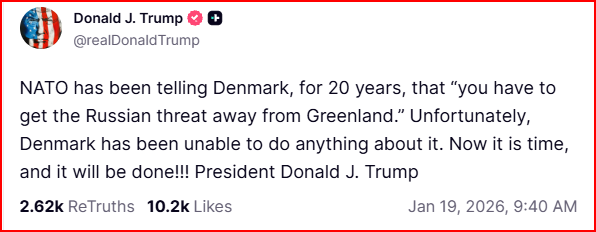
Meanwhile, on Sunday, Trump stated that Denmark hasn’t been successful in getting the “Russian threat” away from the region for 20 years. He warned that, “Now it is time, and it will be done!!!”
EU Backlash, NATO Risks, Trillion-Dollar Cost
Trump’s plan to acquire Greenland has sparked significant controversy, with the European Union (EU) reportedly considering trade retaliation and other measures to counter the U.S. tariff threats.
Furthermore, Rep. Michael McCaul (R-Texas) has cautioned that any U.S. military action to seize Greenland would be a declaration of war against NATO, potentially fracturing the alliance. Pence’s recent comments add to the ongoing debate surrounding the potential geopolitical and economic implications of Trump’s Greenland ambitions.
Meanwhile, experts have questioned the economic justification for the acquisition, warning that it could cost the U.S. nearly $1 trillion over 20 years with limited economic payoff.
While the island holds critical minerals and oil reserves, experts say they are cheaper to extract elsewhere, including within the U.S. The White House estimates the purchase alone at around $700 billion, with hundreds of billions more needed for infrastructure development.
Image via Imagn Images
Disclaimer: This content was partially produced with the help of AI tools and was reviewed and published by Benzinga editors.
Recent Comments