
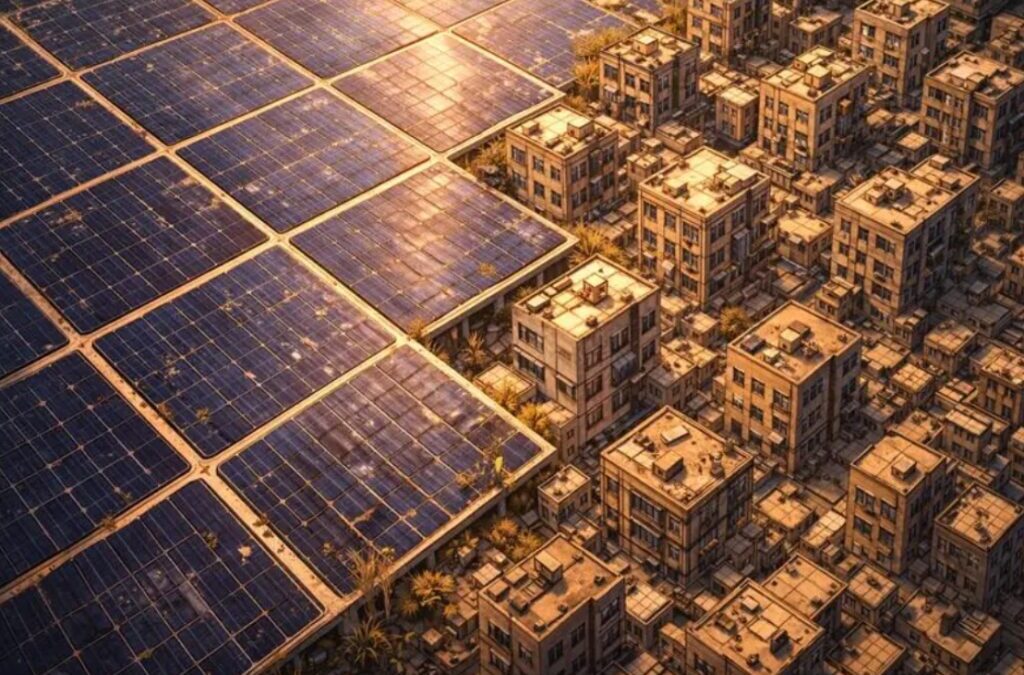
As China shifts from the 14th to the 15th Five-Year Plan, solar tells a story of swelling under policy momentum before a pullback, while property experienced a forced, sharp slowdown
Image Credit: Bamboo Works
In China’s policy framework, five-year plans are less operating manuals for companies and function more as a continually recalibrated outlays for the pace for national development. They reset priorities and resource allocation at each stage, but don’t determine corporate success or failure. Even companies that align perfectly with policy direction can face outcomes far beyond their expectation as regulation, capital flows and competitive dynamics continually shift.
During the recently concluded 14th Five-Year Plan period from 2021 to 2025, solar energy and real estate became the clearest examples of industries that “got the beginning right, but misjudged the ending.” Solar surged under China’s dual-carbon agenda, only to fall into overcapacity and price wars within a few years. Property, meanwhile, cooled rapidly under policies forcing deleveraging and risk-control, dragging the entire industry into a prolonged adjustment. In both cases, the industries’ trajectories were fundamentally altered.
Solar: From acceleration to stall
At the start of the 14th Five-Year Plan, solar power was assigned a clear policy mission: advancing the energy transition, lowering power generation costs, and building a secure, self-sufficient renewable supply chain. Under policy language such as “accelerated development,” “large-scale deployment” and “build whenever feasible,” installed capacity became the core performance metric.
As a result, China’s solar installations surged. New capacity expanded from 48 GW in 2020 to 216 GW in 2023, and exceeded 260 GW in 2024 — a more than fivefold increase in just four years. China cemented its position as the world’s largest solar market, effectively completing the 14th Five-Year Plan’s core task of scaling up capacity.
Yet this explosion in installations failed to translate into sustained industry returns. Capacity across polysilicon, cells and modules was released almost simultaneously. Polysilicon prices collapsed from over 300 yuan ($42.91) per kilogram at their 2022 peak to below 70 yuan by the end of 2024, a decline of more than 70%, with cell and module prices following the same trajectory. Even growing global demand proved insufficient to absorb the simultaneous release of so much capacity, pushing the industry into a “volume-for-price” competition trap.
The deterioration in profitability quickly showed up in company stocks. Over the past five years, Longi Green Energy (601012.SH) has lost about 65% of its market value, Tongwei (600438.SH) nearly 50%, JinkoSolar (688223.SH; JKS.US) more than 55%, and Trina Solar (688599.SH) around 25%. Despite generally rising shipments and revenue, valuation multiples for industry leaders have fallen sharply, reflecting investors’ reassessment of whether solar can still deliver outsized returns after completing its policy-driven expansion.
This shift is also evident in changing policy language. While the 14th Five-Year Plan emphasized “scale,” forward-looking signals for the 15th Five-Year Plan increasingly stress “high-quality development,” “orderly construction,” “grid integration,” and “market mechanisms.” Solar is moving from a phase of mandatory expansion to one of selective consolidation.
Property: Deleveraging hits the entire chain
If solar’s slowdown was a byproduct of encouragement, property’s reversal was the result of a clampdown on risks in a concentrated burst. Early in the 14th Five-Year Plan, the rollout of the “three red lines,” tighter financing rules and other deleveraging measures — compounded by the pandemic — sent core indicators into rapid decline.
According to official data, national housing sales area fell from 1.79 billion square meters in 2021 to about 973 million square meters in 2024, a drop of roughly 45%. In the first 11 months of 2025, sales slipped further to around 787 million square meters. Property investment and new construction starts collapsed in tandem and have yet to bottom out.
Under pressure from tightening funding and falling sales, major developers faced similar outcomes of different magnitude — Vanke (2202.HK; 000002.SZ) entered a period of financial strain, while Evergrande and Country Garden (2007.HK) fell into full-blown crises. Evergrande was forced to delist, and its founder Hui Ka Yan was detained. By some estimates, around 77 Chinese developers have defaulted over the past five years. Surviving firms have been forced to prioritize debt repayment and project delivery, sharply cutting land purchases and new investment — undermining demand across the entire supply chain.
Upstream building materials were hit first. Cement and flat glass output has declined for three consecutive years since 2021. Cement production fell from 2.36 billion tons in 2021 to 1.83 billion tons in 2024, with July 2024 output at just 146 million tons — the lowest monthly figure since 2009. Prices weakened alongside volumes, and even relatively strong players such as China National Building Material (3323.HK) struggled to defend their margins.
Demand also cooled for midstream firms engaged in construction and decoration. Slower residential construction directly affected order flows at China Lesso (2128.HK), while companies like Kuka Home (603816.SH), once buoyed by the “post-property cycle plus consumption upgrade” narrative, lost key growth drivers as new housing supply slowed, compounded by weaker consumer demand and overseas expansion challenges. Over the past five years, Kuka Home’s shares have fallen more than 41%, while China Lesso is down nearly 62%.
Even the relatively defensive property management sector wasn’t immune. As developer deliveries declined, growth in newly managed floor area slowed sharply. Country Garden Services (6098.HK), heavily reliant on its developer parent’s pipeline, saw its scale-driven growth model questioned, with valuation logic shifting from expansion to survival. Its shares have collapsed by more than 90% over five years.
When policy sets the rhythm
What solar and property ultimately share is not a strategic misjudgment, but their position within a tightly choreographed policy system. When that system demands speed, scale and stability — and expects stage-specific objectives to be met within a fixed timeframe — companies have little choice but to keep pace. Industries elevated to center stage in one cycle may be required to slow, or even step back, in the next. Being lifted by the wave, and then left adjusting as it recedes, is part of the system’s rhythm. For solar and property, the task now is simply to regain balance and wait for the next turn of the policy tide.
Author’s Note: This is part 1 in a 5 part series
Benzinga Disclaimer: This article is from an unpaid external contributor. It does not represent Benzinga’s reporting and has not been edited for content or accuracy.
Recent Comments