
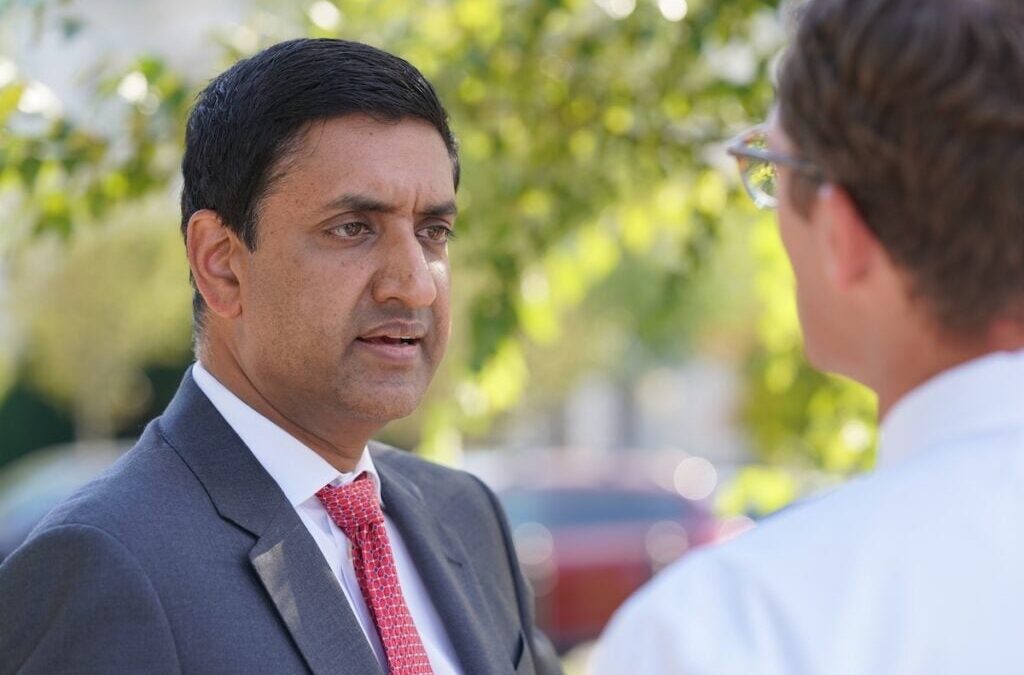
Rep. Ro Khanna (D-Calif.) has stood firm in his support for a billionaire tax, despite threats from some of the state’s wealthiest residents to leave if the tax is implemented.
Khanna Defends Billionaire Tax
Khanna took to X to defend his stance on the billionaire tax, which would tax California residents whose net worth exceeds $1 billion at up to 5% of their assets. Those with at least $20 billion in assets as of Jan. 1, 2026, would face a one-time tax of $1 billion.
He noted that within a 50-mile radius, his district alone accounts for nearly one-third of the U.S. stock market, with five companies having a market capitalization of more than $1 trillion.
Khanna argued that the tax would not deter future innovation in Silicon Valley, citing the region’s rich history of fostering tech giants.
The Congressman wrote on X, “Those saying that we wouldn’t have a future NVIDIA in the Bay if this tax goes into effect are glossing over Silicon Valley history.”
The proposed 1% tax on billionaires would fund healthcare amid federal Medicaid cuts.
“Jensen wasn’t thinking I won’t start this company because I may have to one day pay a 1 percent tax on his billions,” Khanna stated, referencing Nvidia Corp. (NASDAQ:NVDA) founder Jensen Huang‘s decision to launch the chipmaker in Silicon Valley due to semiconductor talent, Stanford University proximity and venture capital access.
Khanna’s comments came in response to a post by journalist Teddy Schleifer, who reported that billionaire venture capitalist Peter Thiel had threatened to leave California if a proposed 1% tax on billionaires were implemented to fund healthcare for the working class.
See Also: Trump Claims Victory Over Government, Jokes He’s Awarding Himself $1 Billion
Proposed Levy Sparks Debate
The proposed billionaire tax has sparked a heated debate in California, with some of the state’s wealthiest residents, including Thiel, a co-founder of Palantir Technologies (NASDAQ:PLTR), considering leaving the state if the tax is implemented.
Khanna’s defense of the tax highlights the growing tension between the state’s ultra-wealthy and its political representatives.
California’s wealthiest residents have long faced scrutiny over their tax contributions. A study found that the effective tax rate for America’s richest 0.0002% fell from 30% to 24% following the 2017 GOP tax overhaul, fueling arguments that the current system disproportionately favors the ultra-wealthy.
Supporters view the proposed billionaire tax as a way to correct this imbalance and ensure that the state’s richest residents contribute a fairer share.
Critics, however, warn of potential unintended consequences. Billionaire investor Bill Ackman and others argue that aggressive tax policies could push entrepreneurs and major employers out of the state, threatening job creation and long-term economic growth—concerns that have intensified broader fears about California’s economic future.
Khanna’s endorsement of the billionaire tax is consistent with his prior positions on wealth distribution.
Read Next:
Photo Courtesy: Phil Pasquini on Shutterstock.com
Disclaimer: This content was partially produced with the help of AI tools and was reviewed and published by Benzinga editors.
Recent Comments