
On Monday, Tesla Inc. (NASDAQ:TSLA) CEO Elon Musk weighed in on an AI debate, siding with Alphabet Inc.’s (NASDAQ:GOOG) (NASDAQ:GOOGL) Google DeepMind CEO Demis Hassabis after Meta Platforms, Inc.’s (NASDAQ:META) outgoing AI chief Yann LeCun dismissed the idea of “general intelligence” as an illusion.
Musk Weighs In On AGI Debate
Musk amplified Hassabis’ rebuttal to LeCun in a post on X, writing simply, “Demis is right,” throwing his support behind the DeepMind chief in a widening public dispute over whether artificial general intelligence, or AGI, is a meaningful concept.
The exchange underscores growing divisions among leading AI researchers over how intelligence should be defined — and whether human intelligence itself can be considered “general.”
See Also: Skanska builds a new City Hall in Franklin, Tennessee, USA, for USD 53M, about SEK 520M
Hassabis Says Brains Are Fundamentally General
Hassabis pushed back strongly against LeCun’s statement that there is “no such thing as general intelligence,” arguing that LeCun is conflating general intelligence with the idea of universal intelligence.
In a detailed post, Hassabis said human brains are among the most complex systems known and are, by design, highly general learning machines.
While acknowledging that no real-world system can escape some degree of specialization, he said the architecture of the human brain — much like modern AI foundation models — is capable of learning any computable task in theory, given sufficient time, memory and data.
He added that humanity’s ability to invent chess, science and modern engineering, despite evolving for survival tasks like hunting and gathering, demonstrates the breadth of human intelligence rather than its limits.
LeCun Calls Humans Extremely Specialized
LeCun also responded to Hassabis’ criticism, saying the disagreement is largely semantic.
He objected to equating “general” with “human-level,” arguing that humans are deeply specialized systems optimized for efficiency in narrow domains.
While conceding that the human brain is theoretically Turing complete, LeCun said it is highly inefficient for most computational problems under real-world constraints.
He also argued that the brain can represent only a vanishingly small fraction of all possible functions, making true generality impossible in practice.
Why This Matters For AI’s Future
The debate highlights a central fault line in AI research: whether AGI is an achievable goal or a misleading label.
Previously, Salesforce Inc. (NYSE:CRM) CEO Marc Benioff, who is investing billions in AI, said the reality of AGI falls short of the hype.
On the other hand, Hassabis has earlier predicted that there is roughly a 50% chance that AGI emerges within the next five years.
Anthropic co-founder Ben Mann has said AGI could be reached by 2028. OpenAI CEO Sam Altman has also suggested AGI could arrive during President Donald Trump’s term in office.
Former Google CEO Eric Schmidt echoed that view at an April fireside chat, saying it is reasonable to expect AGI to emerge sometime between 2028 and 2030.
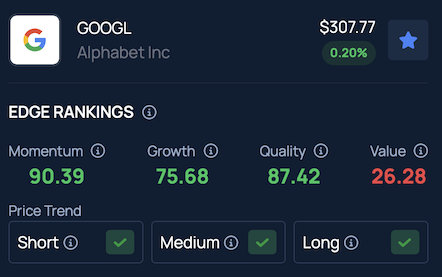
Benzinga Edge Rankings show Google in the 90th percentile for Momentum, with additional indicators offering insight into how it stacks up against peers such as Meta and Tesla.

Read Next:
Photo Courtesy: Photo Agency on Shutterstock.com
Disclaimer: This content was partially produced with the help of AI tools and was reviewed and published by Benzinga editors.
Recent Comments