
On-chain data shows Ethereum (CRYPTO: ETH) remains the blockchain with the fastest wallet growth, followed by XRP (CRYPTO: XRP) and Bitcoin (CRYPTO: BTC).
Ethereum Leads Adoption While Bitcoin Ranks Second
According to data shared by Santiment, Ethereum ranks first among cryptocurrency networks with 167.96 million non-empty wallets, giving it a wide lead in address activity.
Bitcoin follows in second place with 57.62 million wallets, reflecting a more concentrated holding structure.
Ethereum’s dominance in wallet counts reflects its role as the primary settlement layer for decentralized finance, stablecoins, NFTs, and smart contract applications.
Many Ethereum addresses hold small balances tied to protocols, bots, and applications, which significantly boosts wallet totals.
Bitcoin’s lower wallet count points to a different usage pattern.
Rather than transactional density, Bitcoin’s on-chain profile aligns more closely with its role as a store of value, where balances tend to be more concentrated and held for longer periods.
XRP Wallet Growth Continues Despite Price Weakness

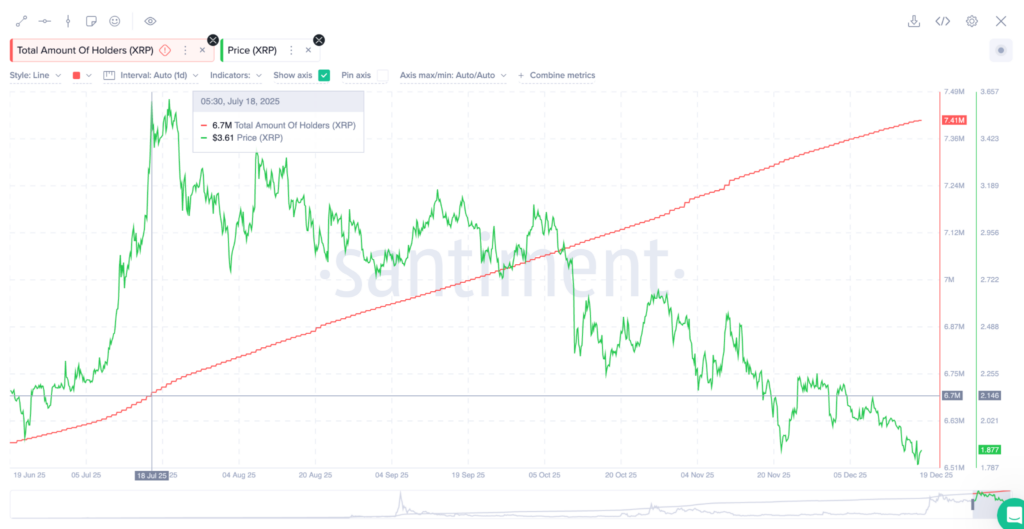
XRP Holder Data by Santiment
Santiment data shows XRP Ledger participation continuing to rise even as XRP price has sharply underperformed since its July peak.
When XRP topped out near $3.66 in mid-July, the network had about 6.7 million non-empty wallets.
That figure has since climbed to 7.41 million, marking an increase of nearly 11% in active accounts.
The growth contrasts with price action, as XRP has fallen close to 50% from its July highs, suggesting rising participation even as market sentiment weakened.
Behind Ethereum, Bitcoin, and XRP, Tether (CRYPTO: USDT) ranks third with 9.63 million non-empty wallets, followed by Dogecoin (CRYPTO: DOGE) at 8.13 million.
Cardano (CRYPTO: ADA) holds about 4.54 million wallets, narrowly ahead of USD Coin (CRYPTO: USDC) at 4.39 million, while Chainlink (CRYPTO: LINK) trails the group with roughly 819,000 wallets.
Where Bitcoin, Ethereum And XRP Face Their Next Technical Test
For XRP the $2.17–$2.20 area continues to cap recoveries, reinforced by Supertrend resistance and prior reaction highs.
A failure to hold the $1.80 base would confirm continuation toward the next demand zone near $1.60, while only a clean break and hold above $2.20 would begin to disrupt the current bearish framework.
For Bitcoin the $90,900–$91,000 zone is the first level that must be reclaimed, aligning with the 0.382 Fibonacci retracement and the falling 20-day EMA.
As long as price remains below that area, upside attempts lack confirmation.
On the downside, failure to hold $87,000 keeps pressure on the rising base near $84,000, which remains the key support before structural damage deepens.
Ethereum continues to respect a downward-sloping resistance line from the October high, with recent rebounds stalling into the clustered 20-day and 50-day EMAs near $3,050–$3,200.
The $3,340 region stands out as a more meaningful pivot, coinciding with prior breakdown support and the upper Bollinger Band.
Below current levels, the $2,750–$2,800 zone remains critical, as it marks the lower band and the last area preventing a deeper retracement toward $2,500.
Read Next:
Image: Shutterstock
Recent Comments