
President Donald Trump’s sweeping executive order aimed at curbing state-level artificial intelligence (AI) regulation is triggering fierce political backlash, legal questions, and sharply divided reactions across Washington, labor groups, and Silicon Valley.
Trump Pushes Single National AI Framework
Trump on Thursday signed an executive order seeking to establish a unified national approach to AI regulation, arguing that state laws have created a fragmented system that threatens U.S. leadership in AI.
The order directs the Justice Department to form an AI Litigation Task Force charged with challenging state AI laws deemed inconsistent with federal policy.
Trump criticized what he called a “patchwork of 50 different regulatory regimes,” saying such rules slow innovation and undermine competitiveness.
The task force could sue states if their AI laws are found to unlawfully regulate interstate commerce, conflict with federal authority, or otherwise violate the Constitution. Trump said a national standard is needed to ensure “the United States wins the AI race.”
See Also: Nvidia Stock Dips After Oracle Snub: Larry Ellison Calls It ‘Chip Neutrality’
White House Defends Move, Targets ‘Doomer’ Laws
White House AI adviser Sriram Krishnan, speaking on CNBC’s Squawk Box, said the administration plans to work with Congress on federal AI legislation while pushing back on overly restrictive state laws.
“The White House is now taking a firm stance,” Krishnan said, describing some state policies as “doomer” regulations that hurt U.S. competitiveness.
He added the order would focus on laws passed in states such as California and Colorado, while stressing that rules protecting children’s safety would not be targeted.
Democrats And Labor Groups Sound Alarm
Democratic lawmakers quickly condemned the move.
Sen. Amy Klobuchar (D-Minn.) called the order “the wrong approach — and most likely illegal,” arguing that it strips away some of the few existing protections Americans have against AI harms.
Sen. Scott Wiener (D-Calif.) said Trump was declaring “war” on state AI transparency laws under the banner of U.S. dominance, while pointing to the latest decision of approving Nvidia Corp (NASDAQ:NVDA) chip sales abroad as contradictory.
Sen. Bernie Sanders (I-Vt.) called the order “unconstitutional” and “extremely dangerous,” warning that unchecked AI threatens privacy, jobs, and democracy.
“We cannot let a handful of oligarchs decide the future of humanity,” he said.
The American Federation of Labor and Congress of Industrial Organizations, or AFL-CIO, also echoed those concerns, accusing Trump of empowering tech billionaires at the expense of workers’ rights and vowing to support state legal challenges.
Wall Street Applauds Trump’s AI Order
Wedbush analyst Dan Ives called the order a major win for U.S. tech firms, saying limits on state regulation remove “significant innovation hurdles.”
The move is widely seen as benefiting companies such as OpenAI, Alphabet Inc. (NASDAQ:GOOG) (NASDAQ:GOOGL), Meta Platforms, Inc. (NASDAQ:META), Microsoft Corp (NASDAQ:MSFT), and Nvidia, which have increased lobbying efforts to curb state-by-state AI rules.
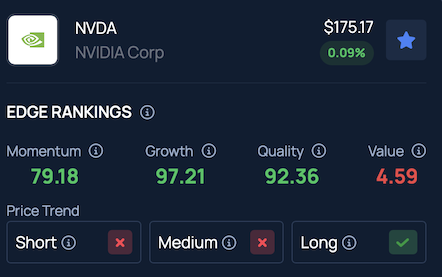
Benzinga’s Edge Stock Rankings rank the company in the 97th percentile for Growth and the 92nd percentile for Quality, highlighting its strong competitive position.

Read Next:
Disclaimer: This content was partially produced with the help of AI tools and was reviewed and published by Benzinga editors.
Image via Shutterstock
Recent Comments